Massive Gas Giant Moon Discovered Orbiting a Super-Jupiter in CD-35 2722 System

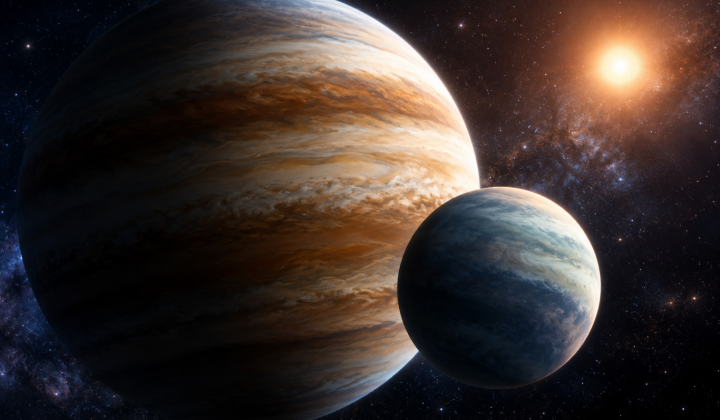
A Moon as Massive as a Giant Planet: Astronomers Uncover an Extraordinary Cosmic Pair
According to Radiotrek — Світ: Date and Time: Wednesday, October 28, 2026, 22:40
Source: Daily Galaxy, Radio Trek
In the star system CD-35 2722, astronomers have identified a potential colossal gas giant moon with a mass comparable to that of a giant planet. This enormous satellite orbits a massive companion whose mass exceeds Jupiter’s by several times. Such a finding challenges existing distinctions between planets and moons beyond our Solar System.
Unlike the rocky or icy moons familiar to us in our own cosmic neighborhood, this newly detected object is a gas giant moon orbiting a super-Jupiter-sized body rather than directly circling a star. Typically, Earth orbits the Sun, and our Moon orbits Earth, but here the satellite revolves around a massive planetary companion.
Further observations are essential to confirm this satellite’s existence and to uncover its origins. An anonymous researcher commented, "The candidate moon is a gas giant orbiting a heavy companion several times Jupiter’s mass." This discovery holds the potential to reshape our understanding of how planetary systems form and evolve across the universe.
Reevaluating Cosmic Classifications
The presence of such a large gas giant moon raises new questions about how celestial bodies are categorized and how they interact. Should this gas giant satellite be confirmed, it could transform conventional models of planetary system architectures.
Scientists anticipate that ongoing and future studies will shed light on the processes that create moons and clarify their significance in the development of planetary systems. This discovery marks an important step toward deepening our knowledge of planetary formation on a cosmic scale.
This intriguing discovery prompts further exploration into the classification of celestial bodies, similar to recent findings regarding a potential ninth planet in our Solar System. As scientists continue to unravel the complexities of planetary systems, understanding the dynamics of such massive moons could provide valuable insights into the formation and evolution of our own cosmic neighborhood.

Read also