The world's most powerful hydraulic hammer for offshore wind farms

A Titan in the Service of Wind
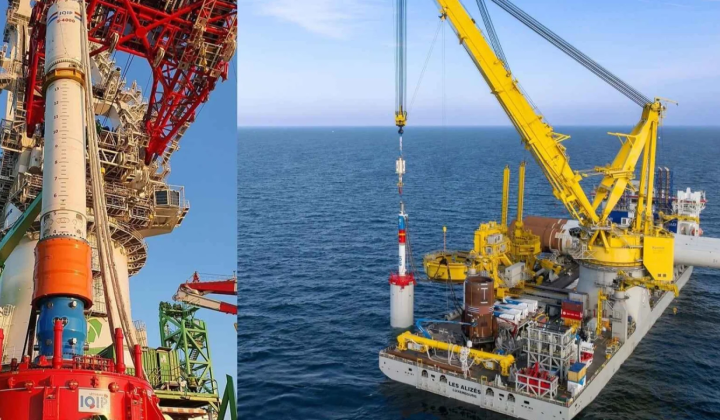
According to НВ — Техно: The company IQIP has introduced the latest hydraulic hammer Hydrohammer IQ8, which has become the most powerful device in the world for driving foundations of offshore wind turbines. The weight of the Hydrohammer IQ8 is 700 tons, and its length is 23.6 meters. According to the manufacturer, the hammer is capable of delivering over 7500 kilojoules of energy with each strike. This makes it especially effective in the process of installing monopiles for wind turbines.
Technical Specifications and Innovations
To operate, the Hydrohammer IQ8 requires a flow of hydraulic oil of 9900 liters per minute, allowing it to work continuously at full capacity. In challenging soil conditions, the IQ8 can deliver 20% more energy than indicated in its technical specifications. This feature is crucial for improving the efficiency of installing monopiles, which in the Inch Cape project off the coast of Scotland reach a height of 102 meters and have a diameter of 11.5 meters. Each of these monopiles weighs about 2300 tons.
The Inch Cape project plans to install 54 monopiles by June 11, 2026. Their installation process was carried out using the heavy-lift vessel Les Alizés from Jan De Nul. For the final embedding of the monopiles into challenging soil, a booster mode was used, as well as a unique remotely operated equipment for lifting piles with a load capacity of 3500 tons. This is the first-time solution applied in similar projects, demonstrating an innovative approach to constructing wind farms in marine conditions.
The innovations presented by IQIP emphasize the importance of technological progress in the energy sector, particularly in the field of renewable energy sources.
The introduction of the Hydrohammer IQ8 can significantly change the landscape of offshore wind energy, as the efficiency of monopile installation is critically important for the implementation of large-scale projects in this field. Given the growing demand for renewable energy sources, such technologies can help accelerate the transition to cleaner energy, reducing construction costs and increasing the reliability of wind installations. The creation of such innovations opens new opportunities for the development of offshore wind farms, which, in turn, can positively impact the energy security of countries seeking to reduce dependence on fossil fuels.

Read also