Possible Remains of the Miriokephalon Castle Linked to the 1176 Battle Unearthed in Turkey

Discovery of the Miriokephalon Castle Ruins
According to НВ — Техно: Archaeologists from Pamukkale University have uncovered what are believed to be the ruins of Miriokephalon Castle near Çivril in Denizli Province, Turkey. This site is historically connected to the pivotal 1176 battle between the Byzantine Empire and the Seljuk Turks. The identification of these ruins was made possible through a combination of topographical analysis, architectural studies, and examination of historical texts. In a related find, Byzantine artifacts dating back 1,400 years, linked to the Byzantine-Sasanian War (602–628 AD), were also discovered elsewhere in Turkey.
The castle ruins are situated approximately seven kilometers northeast of Çivril and are associated with the Battle of Miriokephalon, fought on September 17, 1176. This clash involved the armies of Byzantine Emperor Manuel I Komnenos and Seljuk Sultan Kilij Arslan II. The settlement where the ruins lie covers an area of about 150 hectares, measuring roughly 530 by 300 meters.
Archaeological Findings
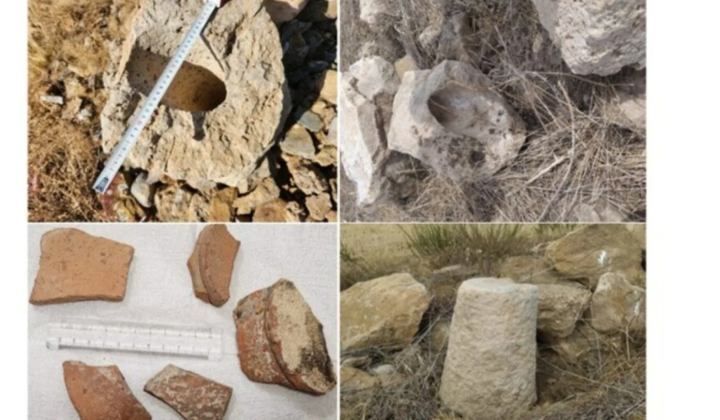
Excavations at the site revealed:
- Foundations of defensive walls;
- Two square towers, each about 6 by 7 meters in size;
- Wells or cisterns;
- Architectural stone blocks.
Ceramic fragments recovered from the digs date back to the 4th–3rd centuries BCE, as well as from Roman and early Byzantine periods. Additionally, pottery shards from the 5th–6th centuries AD were found. Archaeological work at the location began in 2010, with the key identification breakthrough occurring in summer 2023.
The lead researchers, Professor Hasan Kara and Associate Professor İbrahim Balık, emphasize that confirming the castle’s identity requires further interdisciplinary studies and additional excavations. Professor Kara noted,
"There is no unanimous agreement on the exact location of the Battle of Miriokephalon."
Both scholars believe the ruins they uncovered
are very likely the lost Miriokephalon Castle.
Separately, in 2021, 19 Byzantine-period artifacts around 1,400 years old were found in the ancient city of Uzuncaburç in Mersin Province. These relics, linked to the Byzantine-Sasanian War, were discovered within a 23-meter tower dating from the late 6th or early 7th century AD. Such findings highlight the critical role of archaeology in deepening our understanding of the region’s rich historical and cultural legacy.
The identification of the Miriokephalon Castle ruins marks a significant advancement in the study of Byzantine history and its military conflicts with the Seljuks. It underscores how meticulous archaeological research can illuminate key historical events that shaped the development of this part of Anatolia. The artifacts and structural remains not only shed light on medieval warfare but also offer insights into the social and economic life of the era’s inhabitants.
As archaeological discoveries continue to shed light on historical sites, another intriguing find has emerged in Hungary. A mysterious heated stone shaft was unearthed at the medieval Esztergom Castle, prompting experts to explore its potential connections to the region's rich history. Such discoveries not only enhance our understanding of past civilizations but also draw parallels to the significant events surrounding the Miriokephalon Castle, highlighting the ongoing quest for historical knowledge.

Read also