Scientists Achieve Nearly Perfect Non-Destructive Qubit Reading with 99.85% Accuracy

A Breakthrough in Qubit Measurement
According to НВ — Техно: Quantum processors are becoming more practical thanks to a newly developed technique that reads qubits without altering their state. Led by Professors José Carlos Egues and Yu Gui Yao, researchers have created a method that extracts quantum state information with an exceptional 99.85% accuracy. This approach leverages an Andreev qubit paired with a highly sensitive sQUID magnetometer, eliminating the need for auxiliary qubits. As a result, it simplifies quantum processor designs and paves the way for more efficient quantum computing.
Qubits exist in a superposition, simultaneously representing both 0 and 1. Traditionally, measuring a qubit directly disturbs its quantum state, complicating computations. Existing techniques rely on auxiliary qubits to transfer information for measurement, which adds complexity to circuits, increases wiring, and slows down processing speeds.
Innovations Behind the New Approach
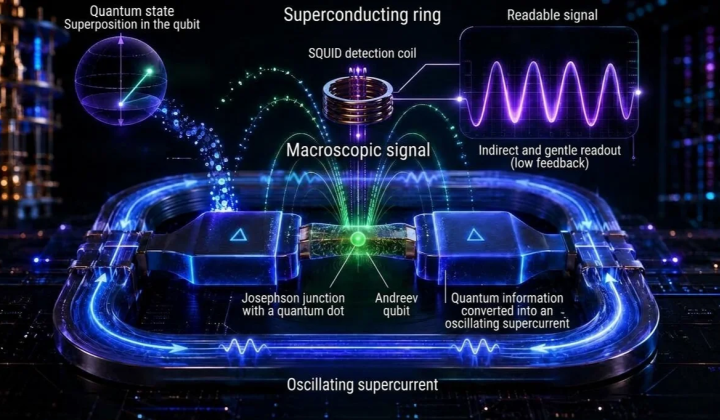
The new strategy utilizes an Andreev qubit formed in a nanostructure of indium arsenide sandwiched between two superconductors. This qubit generates an electrical supercurrent that flows without external voltage, oscillating autonomously due to quantum wave effects and producing a detectable macroscopic signal. The quantum information is encoded in the oscillating supercurrent’s amplitude and phase, reflecting the probabilities of the qubit’s 0 and 1 states.
To read this signal non-invasively, the team employed an ultra-sensitive sQUID magnetometer that detects the subtle magnetic field fluctuations caused by the supercurrent. Achieving a readout accuracy of up to 99.85% even in noisy environments meets the stringent requirements of current quantum error correction protocols.
"This phenomenon is truly remarkable," said Professor José Carlos Egues.
He further explained, "If one pointer trembles slightly, its neighbor senses the field without pushing it too hard. The interaction is so delicate that the quantum superposition remains intact."
The findings, published in the journal Physical Review B, mark a significant advancement in quantum technology. This innovation promises to revolutionize quantum computing by reducing hardware complexity while enhancing performance.
By enabling more straightforward and accurate qubit measurements, this development could have far-reaching implications for fields such as cryptography and materials science. Simplifying quantum processor architectures may lead to faster, more accessible quantum devices, accelerating the overall progress of quantum technologies worldwide.
The advancements in quantum technology continue to unfold, with recent developments showcasing not only improved qubit measurement techniques but also precise computational methods. For instance, researchers in Chicago have crafted an innovative approach for accurately modeling energy loss from spin defects in crystals. This research complements the ongoing efforts to enhance quantum computing efficiency, emphasizing the critical interplay between measurement accuracy and computational fidelity in advancing the field.

Read also