Astronomers Identify Ultra-Bright Galaxies with Intense Star Formation in the Early Universe

Discovery of Exceptionally Luminous Galaxies
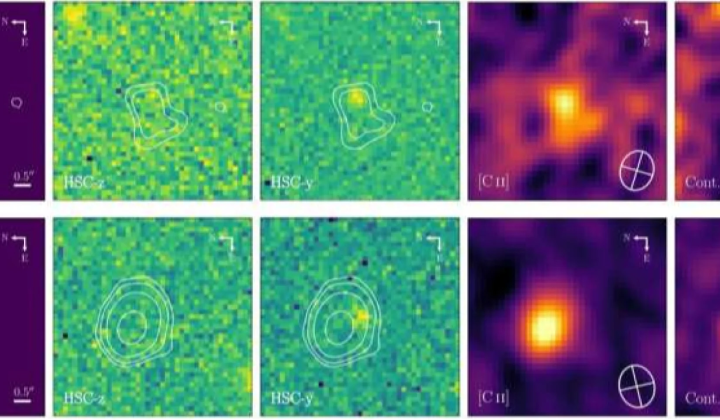
According to НВ — Техно: An international research team led by Sara El-Bosman from Leiden University has made a groundbreaking discovery using the James Webb Space Telescope (JWST) alongside the ALMA radio telescopes. Their study revealed that the objects J1450−0144 and J1429−0104, previously classified as faint quasars, are in fact ultra-bright galaxies exhibiting extraordinary rates of star formation during the Universe’s infancy. These galaxies existed when the Universe was less than 900 million years old, corresponding to redshifts of 6.63 and 6.80, respectively.
Initially, the SHELLQs survey had categorized J1450−0144 and J1429−0104 as faint quasars. However, detailed spectral analysis unveiled P Cygni-type profiles and prominent helium emission lines. Notably, broad Lyman-alpha and magnesium lines were absent. The massive stars within these galaxies have masses exceeding 100 to 200 times that of the Sun, with each galaxy hosting between 100,000 and 1 million such supermassive stars. Their star formation rates are remarkably high, ranging from 300 to 540 solar masses per year.
Observational Insights and Their Implications
ALMA’s millimeter-wave observations detected strong emissions from cold dust and gas. In galaxy J1429−0104, ultraviolet radiation is offset from the main dust and gas concentration by approximately 1.66×10¹⁷ kilometers (around 17,600 light-years). This displacement may be caused by galaxy mergers or powerful stellar winds pushing dust outward. J1450−0144 and J1429−0104 represent the first confirmed members of a new class of ultra-bright galaxies serving as natural laboratories for studying the early Universe.
This discovery has the potential to significantly reshape our understanding of star formation processes during the Universe’s formative epochs.
Uncovering these ultra-bright galaxies is a crucial advancement in exploring cosmic evolution, providing valuable insights into how stars formed when the Universe was in its earliest stages. Such findings help explain the intense star formation observed shortly after the Big Bang, and ongoing studies will enhance our comprehension of the diverse galaxy populations and their characteristics during the Universe’s dawn.
In addition to these remarkable findings, recent studies have also unveiled a fascinating new group of celestial objects, specifically the faint remnants of radio galaxies. Understanding these remnants may provide further insights into the evolution of galaxies and their formation processes in the early Universe. For more on this intriguing discovery, explore the details in our article about the newly identified population of radio galaxy remnants.