Scientists Discover How to Extract DNA from Ancient Manuscripts Without Causing Damage

A Breakthrough Technique for Gathering Genetic Material
According to НВ — Техно: June 30, 9:00 PM
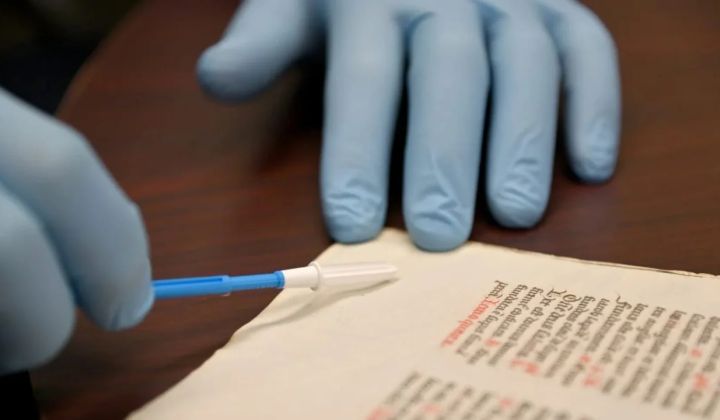
Researchers have introduced a non-destructive method for collecting cellular samples from historical parchment manuscripts using cytological brushes for genetic analysis. This approach enables the retrieval of genetic data without harming culturally significant artifacts, marking a major advancement in the study of history and culture.
Examining the Parchment
Parchment, derived from animal skins, has been employed for millennia across various regions, including Europe, the Middle East, and parts of Africa. For their study, scientists applied this non-invasive sampling technique to 91 manuscripts from the Rubenstein Library at Duke University. These documents span a wide geographical range, from England to Ethiopia, and were created between the late eighth and early twentieth centuries.
The procedure involves gently wiping the parchment with a cytological brush. These brushes, typically used for Pap smears, proved effective at collecting cellular material without compromising the artifact's integrity.
“Since parchments are made from animal skins, they often yield genetic information.”
Tim Stinson
This genetic data opens up new avenues for exploring the past, providing insights into when and where specific manuscripts were produced.
Stinson also emphasized that “this work is particularly important because one of the biggest challenges for this emerging field of genetic analysis has always been access to historical parchments.” He noted that “our research shows we can collect samples without harming the parchments, and that is a major step forward.” Brin, one of the study participants, added that “cytological brushes can be used dry, and they perform the task excellently.”
The researchers are leveraging cutting-edge technologies and genetic analysis methods to obtain new, empirically validated information about historical, cultural, and agricultural practices. Stinson stated that the team is “excited about the potential of this field” and is currently seeking funding for further research. He also remarked, “We have demonstrated that this is a vast, previously untapped source of historical information, and we want to continue this pioneering work.”
This innovative approach to collecting genetic material from historical documents could significantly transform how history and culture are studied. One of its greatest advantages is the ability to obtain information without risking damage to artifacts, which previously posed a serious barrier to research. The significance of this work lies not only in expanding our understanding of the past but also in its potential to foster new research directions in history, archaeology, and cultural studies.
This innovative approach to genetic extraction not only preserves the integrity of historical documents but also parallels recent advancements in genetic research. For instance, scientists have recently made headlines by successfully editing human embryo DNA using a groundbreaking technique. Such developments highlight the rapid evolution of genetic technologies, which continue to reshape our understanding of biology and history. To explore this exciting progress in genetic manipulation, click here.

Read also