Discovery of Quark-Gluon Plasma in Oxygen and Neon Nucleus Collisions at the Large Hadron Collider

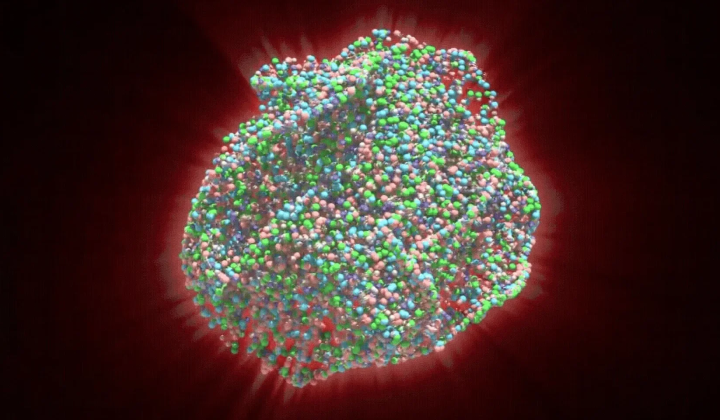
A Breakthrough in Particle Physics
According to НВ — Техно: On November 4, 2023, at 07:59, four major experimental teams at the Large Hadron Collider-ALICE, ATLAS, CMS, and LHCb-announced a groundbreaking discovery. They observed quark-gluon plasma (QGP) formed during collisions of oxygen and neon nuclei, overturning the previous belief that this exotic state of matter could only be created through collisions involving much heavier nuclei, such as lead, which is about 200 times more massive than a proton.
The Importance of Quark-Gluon Plasma
Quark-gluon plasma is an extraordinary phase of matter that existed just microseconds after the Big Bang nearly 14 billion years ago. Its temperature exceeds that of the Sun’s core by a factor of 100,000, making its study crucial for understanding the early universe. In these experiments, the ATLAS detector recorded the slowing down of high-energy particles, while CMS and LHCb teams observed a suppression in the production of heavy particles-an effect that was notably stronger in neon collisions compared to oxygen.
The ALICE detector revealed coherent particle flow resembling wave patterns, characteristic of a nearly perfect fluid at extreme temperatures. This finding opens new avenues to probe the primordial state of matter present at the dawn of the cosmos. To capitalize on these advances, CERN is preparing a significant upgrade of the accelerator to a high-luminosity version, promising new possibilities for future discoveries.
Detecting quark-gluon plasma in collisions involving lighter nuclei like oxygen and neon challenges existing models in particle physics and cosmology. This discovery not only confirms the existence of this extreme matter state beyond heavy ion collisions but also suggests fresh directions for research into the fundamental forces shaping our universe. The planned high-luminosity upgrade at CERN highlights the growing scientific enthusiasm for exploring QGP and other exotic matter states, potentially leading to transformative breakthroughs in physics.
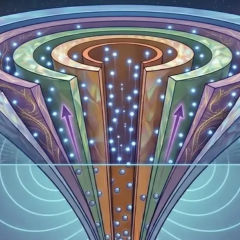
This recent finding adds to the growing body of evidence regarding the complex nature of quark-gluon plasma. In a related study, researchers have identified quark vortices in the early universe's QGP, providing further insights into its behavior and properties. Understanding these phenomena is crucial for advancing our knowledge of particle physics and the conditions that existed shortly after the Big Bang.

Read also