CERN’s LHCb Detects Exceptionally Rare Bd → Muon-Muon Decay for the First Time

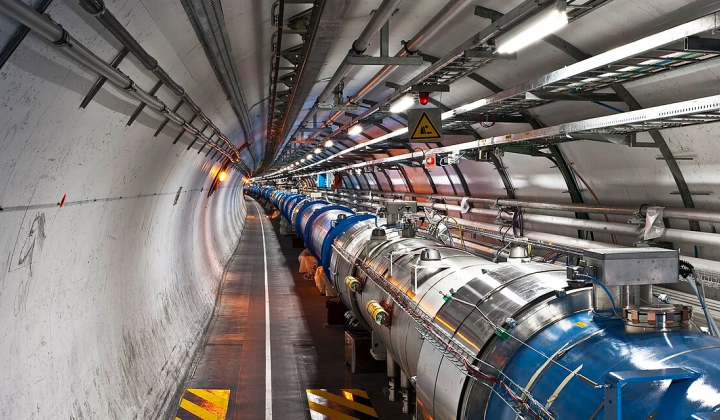
Breakthrough Observation at CERN's LHCb Experiment
According to НВ — Техно: Scientists working with the LHCb detector at CERN’s Large Hadron Collider have successfully observed the extraordinarily rare decay of the Bd particle into two muons. This decay process occurs only once in every 10 billion events, highlighting its exceptional rarity. The discovery was made possible by significant upgrades to the LHCb detector, including the installation of a silicon pixel detector positioned just 5 millimeters from the particle beams. These enhancements increased the data collection rate fivefold, enabling researchers to achieve a statistically meaningful signal with a significance of 3.2 sigma.
Significance and Future Outlook
The LHCb experiment is part of a broader effort to test the predictions of the Standard Model of particle physics. While current measurements align with the model’s expectations, ultra-rare decays such as Bd → muon-muon are sensitive probes for potential new particles that have yet to be discovered. The quarks involved in this decay exist for an incredibly brief duration of about one and a half trillionths of a trillionth of a second.
The detector upgrade was realized through the collaboration of researchers from the University of Manchester and nearly 90 UK-based companies. This partnership paves the way for continued data collection into the early 2030s. An anticipated tenfold increase in data processing speed will allow physicists to explore phenomena at the zeptometer scale-a billionth of a trillionth of a meter-opening new frontiers in our understanding of the subatomic realm.
This achievement underscores the critical role of cutting-edge technology in advancing physics research and unveiling previously hidden aspects of nature.
The ongoing progress of the LHCb experiment holds promise for further validation of the Standard Model and the potential discovery of new particles that could profoundly alter our comprehension of fundamental physics. Beyond academic inquiry, these advancements may drive future technological innovations and contribute to the development of novel materials.
This remarkable finding adds to the growing body of evidence surrounding rare decays, similar to the recent observation of the B⁰ meson decay into muons, which reinforces the predictions of the Standard Model. For a deeper understanding of how these discoveries interconnect and their implications for particle physics, explore more about this significant event here.

Read also