Ten HR Analytics Trends Shaping 2026: The Rise of HR as a Strategic Business Partner

The State of People Analytics in 2026
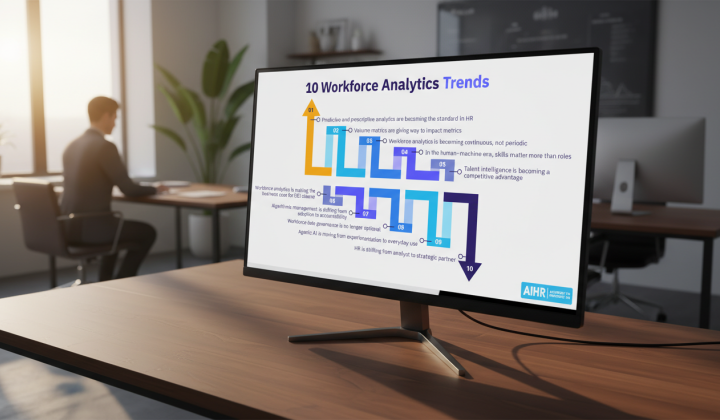
According to AIHR: By 2026, people analytics will be a critical tool, fundamentally transforming HR into a strategic partner for business leadership. This shift is driven by ten key trends that signal a profound change in how workforce data is utilized. Companies are expected to move beyond simple historical reporting toward predictive and prescriptive analytics, enabling them to better forecast organizational needs and adapt proactively. This evolution is crucial as businesses navigate an increasingly complex and data-driven global economy.
A significant aspect of this change is a shift in focus from volume metrics to impact metrics. Organizations will begin to measure not just headcount, but the tangible contribution of their workforce to overall business outcomes. Furthermore, people analytics will become a continuous, real-time function rather than a periodic exercise, ensuring constant data monitoring and swift responses to environmental changes.
Emerging Challenges and New Methodologies
In the face of modern challenges, the era of human-machine collaboration will place a greater premium on employee skills than on formal job titles. This is corroborated by data from Manpower Group, which reports that 74% of employers struggle to find the necessary skills. Talent intelligence will also emerge as a key competitive advantage in the global labor market.
Additionally, people analytics will help build a clearer, data-driven business case for Diversity, Equity, and Inclusion (DEI) strategies. This growing need for data governance is highlighted by the fact that 90% of U.S. companies use at least one tool for employee monitoring. However, significant knowledge gaps persist, with 28% of managers lacking clarity on algorithmic accountability and 27% not understanding how these tools generate their recommendations.
Algorithmic management is evolving from mere implementation to a focus on accountability, underscoring the critical importance of ethics in new technology adoption. A striking 84% of senior HR leaders indicate a need for guidance to ensure data privacy and fairness. Effective workforce data management is now mandatory, and agentic artificial intelligence is moving from experimentation to everyday use. For instance, Salesforce's Agentforce AI has already processed over 500,000 customer dialogues.
These trends collectively indicate that HR has the opportunity to evolve from an analytical function to a true strategic partner, leveraging new technologies and a deeper understanding of business imperatives. A McKinsey study reveals that only 12% of HR leaders currently engage in strategic workforce planning with a horizon of three years or more, highlighting the urgent need for change in this domain. These developments are forging a new reality for people management, where data forms the foundation for decision-making and strategic organizational development.
The implications of these shifts could significantly impact a company's competitiveness in the modern labor market. The growing role of people analytics within HR underscores the necessity for organizations to adapt to new technological realities and prioritize strategic planning to ensure long-term success. HR leaders must pay close attention to these trends and innovations to remain at the forefront of effective talent management.

Read also