Japanese Firm Unveils Diamond-Based Quantum Computer Prototype Operating at 1.5 Kelvin

Diamond Qubits Replace Superconductors
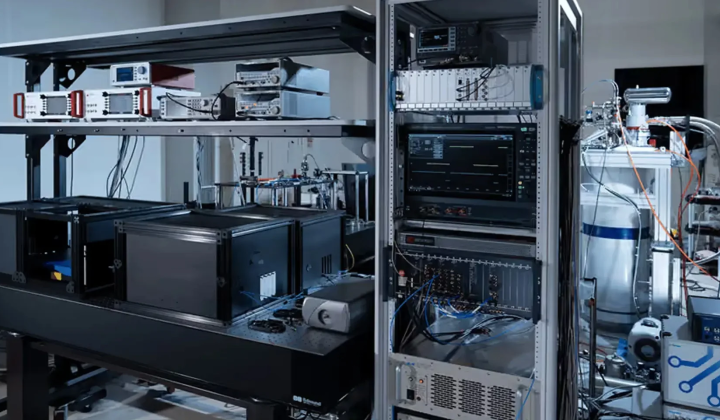
According to НВ — Техно: A Japanese company has engineered a prototype quantum computer that utilizes diamond spin qubits functioning at approximately 1.5 Kelvin-about 1.5 degrees higher than conventional superconducting quantum devices. The system's core innovation lies in employing tin-vacancy (SnV) centers, where tin atoms occupy positions between two vacancies in the diamond lattice. These qubits exhibit enhanced resistance to electromagnetic interference, offering a significant advantage over earlier technologies.
SnV-based qubits emit photons that are ten times brighter than those from comparable systems, unlocking new possibilities for quantum computation. To integrate these diamond qubits with aluminum oxide waveguides on silicon substrates, the diamond plates were thinned from several hundred micrometers down to hundreds of nanometers. Control over the qubits is achieved using a combination of light, microwave, and radiofrequency pulses, enabling highly precise computational operations.
Advancing the Future of Quantum Computing
The company aims to link multiple quantum modules into a scalable network by 2027. Their roadmap includes building a 250-logical-qubit machine by the fiscal year 2030 and expanding to a 1,000-qubit system by 2035. These ambitious milestones reflect the organization's goal to become a frontrunner in quantum technology through cutting-edge approaches to computing hardware.
This diamond-based quantum computer development holds transformative potential for data processing technologies. With improved noise resilience and significantly brighter photon emission, it promises greater efficiency in tackling complex computational challenges, applicable in fields ranging from cryptography to advanced system optimization.
Successful realization of these plans could drive major breakthroughs in quantum technology and revolutionize the broader landscape of computational science.
As advancements in quantum technology continue to emerge, the recent unveiling of a diamond-based quantum computer prototype by a Japanese firm highlights the competitive landscape. Notably, Quantinuum's H2 quantum computer in the UK has also made headlines by surpassing the capabilities of traditional machines, further emphasizing the rapid evolution in this field.

Read also