More Than a Millennium Before Stonehenge: A Czech Sanctuary Emerges

Outdating Stonehenge by a Millennium
According to НВ — Техно: Near the village of Chleby in the Nymburk district of Central Bohemia, researchers are investigating a 6,500-year-old Neolithic sanctuary. The site offers a rare glimpse into Neolithic ceremonial life in Central Europe. Its construction predates the earliest known phase of Stonehenge by more than a thousand years, giving the monument major significance for understanding early civilizations.
The enclosure measures roughly 230 meters across. It was originally surrounded by a ditch more than 2.5 meters deep, and twelve entrances were cut into this boundary. Their positions appear calibrated to follow the movements of the Sun and Moon, with each gateway tied to specific celestial events:
- One viewing point corresponds to the extreme positions of lunar rise and set over an approximately 18.6-year period, known as the Great Lunar Standstill.
- Another alignment links the sunrise at the summer solstice with the sunset at the winter solstice.
Excavations have been directed by Petr Krištuf of the University of West Bohemia in Pilsen. Within the sanctuary, archaeologists have found bull skulls and horns, indicating the site was used for rituals. Jan Turek of Charles University observed:
“The bull was an important religious symbol in early farming societies.”
In the Early Bronze Age, a portion of the area was reused by the Únětice culture for burials. Several graves were uncovered during research carried out in 2016, offering further evidence of the sanctuary's long ritual role.
By the Iron Age, the enclosed settlement had clearly lost its earlier importance, and the ditch was eventually filled in. That gradual abandonment mirrors a broader evolution in social organization and land use across the region. The discovery near Chleby therefore opens new possibilities for investigating prehistoric cultures in Central Europe and comparing them with famous monuments such as Stonehenge.
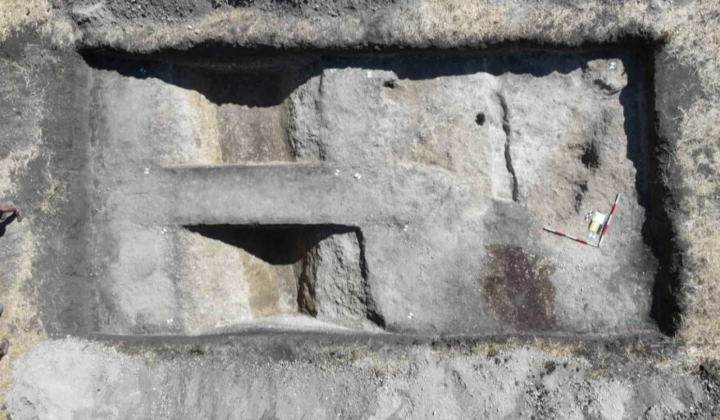
A photograph of the site, constructed more than a millennium before Stonehenge's earliest phase, illustrates the sheer scale of the find. Research is still underway, and researchers hope to uncover additional artifacts that will illuminate ancestral lifeways and religious practices.
This Czech discovery bolsters the view that early farming societies possessed sophisticated methods for monitoring the heavens, enabling them to plan agricultural cycles and stage ceremonies. It also suggests that monumental ritual buildings existed far beyond the boundaries of familiar archaeological landmarks like Stonehenge, potentially transforming current interpretations of prehistoric belief systems. The ongoing studies may lay the groundwork for further archaeological and historical research in Central Europe.

Read also