NASA's Artemis 2 Crew Prepares for Pacific Splashdown on April 11

Artemis 2 Crew's Return to Earth
According to Главком: The crew of NASA's Artemis 2 lunar mission is scheduled to splash down in the Pacific Ocean off the coast of California on April 11 at 3:00 AM Kyiv time (April 10 at 8:00 PM local time). The recovery ship USS John P. Murtha has already deployed to the anticipated landing zone to meet and retrieve the astronauts upon their return to Earth. This splashdown marks the critical final phase of a historic journey beyond Earth's orbit.
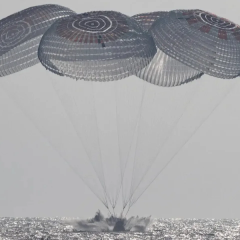
The Orion spacecraft will re-enter Earth's atmosphere at an altitude of 120 km, traveling at a staggering speed of 40,000 km/h. Its speed will drop to 523 km/h by the time it reaches 8,000 m in altitude. At 2,896 m and a speed of 209 km/h, the main parachutes will deploy, slowing the capsule to less than 32 km/h to ensure a safe and gentle ocean landing.
Mission Challenges and Historic Milestones
The Artemis 2 mission encountered several technical issues during its flight. Communication with the crew was partially lost 51 minutes after launch, a problem preliminarily attributed to a software glitch in a communications module. A malfunction in the waste collection system inside the capsule further complicated flight conditions. The astronauts also reported hearing strange whistling sounds, which were caused by an interaction between the VHF radios on the lunar and command modules; when the two spacecraft were in close proximity, their radio signals created a resonant whistle.
Despite these challenges, Artemis 2 is set to achieve several historic firsts:
- For the first time in 54 years, humans will have traveled beyond Earth's orbit to the vicinity of the Moon.
- For the first time since 1972, astronauts will see the far side of the Moon with their own eyes.
- This mission will be the first lunar flyby to include a woman, an African American, and a non-U.S. citizen among its crew.
The astronauts will reach a distance of 406,841 kilometers from Earth, surpassing the record set by the 1970 mission by 6,400 kilometers.
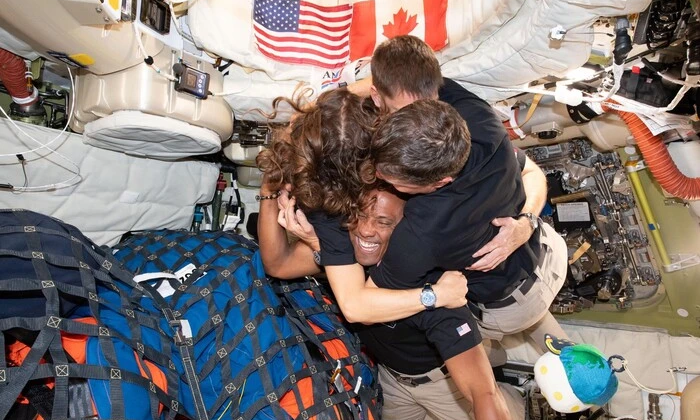
The Orion capsule is crewed by astronauts Reid Wiseman, Victor Glover, Christina Koch, and Jeremy Hansen. Victor Glover is the first Black astronaut on a lunar mission, Christina Koch is the first woman, and Jeremy Hansen is the first Canadian to venture into deep space. This diverse crew composition underscores NASA's commitment to broadening participation in human spaceflight.
This mission highlights the importance of international cooperation in space exploration and opens new horizons for humanity's future in space. The successful splashdown of Artemis 2 represents a vital step in NASA's program to return humans to the Moon and prepare for future missions to Mars. It validates the technologies and procedures that will be essential for the upcoming Artemis 3 lunar landing mission.
As the Artemis 2 crew prepares for their historic splashdown, it's worth noting that they have already set a remarkable distance record, venturing farther from Earth than any humans before. This unprecedented journey highlights the mission's significance in expanding our understanding of space exploration. For more details on their record-breaking travel and the implications for future lunar missions, read about how the Artemis II crew shattered distance records.

Read also