Discovery of 84 Hyper-Soft X-ray Sources in Nearby Galaxies Including Andromeda

Identifying a New Class of Hyper-Soft X-ray Emitters
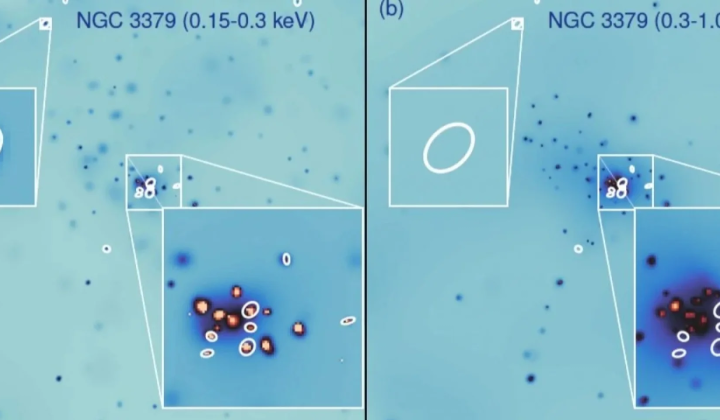
According to НВ — Техно: Astronomers have uncovered 84 hyper-soft X-ray sources across six neighboring galaxies, among them Andromeda and M101. Previously hidden due to their faint X-ray signals being absorbed by interstellar gas, these sources predominantly emit in the extreme ultraviolet range. This breakthrough was achieved by analyzing archival data from NASA's Chandra X-ray Observatory and confirmed through observations with the XMM-Newton telescope. The detected sources likely represent a variety of cosmic objects such as white dwarfs, neutron stars, and black holes, offering fresh insights into the origins of Type Ia supernovae.
Characteristics and Distribution of the Sources
Between 7 and 21 such hyper-soft sources were identified specifically in Andromeda and M101. Some of these were independently observed by XMM-Newton. Less than 3% of the detected sources are thought to be unrelated background objects along the line of sight. In M101, many sources align with the galaxy’s spiral arms, while in elliptical galaxies, they tend to be associated with older stellar populations.
Due to detector contamination, Chandra captures limited light in the relevant wavelength, meaning the sources discovered represent the brightest examples of this class. The term “hyper-soft” describes the nature of their emission rather than defining a specific object type. Their radiation output can exceed the Sun’s by hundreds of thousands to millions of times. This discovery helps bridge the gap between known white dwarfs and the progenitors of Type Ia supernovae. As Mustafa Muhibullah explained:
“If even some of these sources turn out to be white dwarfs accumulating matter and sustaining nuclear burning, they could fill an important gap between known white dwarfs and Type Ia supernovae.”
The strong ultraviolet radiation emitted by these sources may have significant effects on the gas within their host galaxies. To better understand their nature, more precise temperature measurements are necessary. Coordinated ultraviolet and X-ray observations will be key to accurately identifying these objects.
Overall, the identification of 84 hyper-soft X-ray sources opens new avenues for exploring diverse cosmic phenomena and their roles in galaxy evolution, as well as shedding light on the mechanisms behind Type Ia supernovae. This research stands to substantially deepen our comprehension of complex astrophysical processes and could pave the way for future astronomical discoveries.
This discovery not only sheds light on hyper-soft X-ray sources but also enhances our understanding of cosmic phenomena. For instance, recent findings suggest that supermassive black holes generate powerful cosmic winds that exceed initial predictions by a significant margin. Such insights could further elucidate the interactions between various cosmic entities and their environments.

Read also