Astronomers Detect the Most Powerful Gas Outflow Ever Seen from a Black Hole

Discovery of Quasar J2318
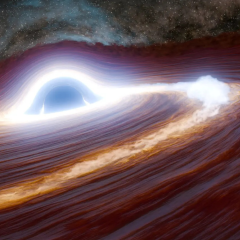
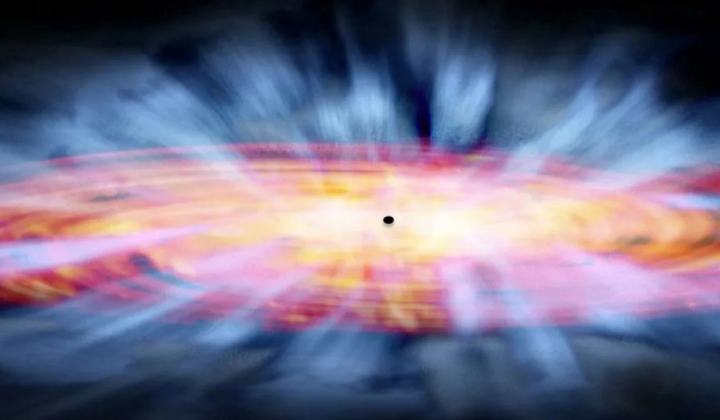
According to НВ — Техно: On June 8 at 12:30, scientists identified an extraordinarily powerful ultraviolet gas stream erupting from a supermassive black hole in quasar J2318, located in the constellation Pegasus. The black hole at the heart of J2318 has a staggering mass 1.7 billion times that of the Sun, and the ejected material is accelerating to 30% of the speed of light. This finding was announced by a research team from York University and published in The Astrophysical Journal.
Research and Findings
The study of quasar J2318 was made possible after the object was spotted in archival data from the Sloan Digital Sky Survey (SDSS). Undergraduate student Marianne Veltri first noticed unusual spectral features while working on her bachelor’s project. To confirm the discovery, the team used the Gemini North telescope, located in Hawaii.
Professor Patrick Hall, one of the lead researchers, noted: 'The black hole’s mass itself is typical, but the speed of the gas outflow far exceeds what we usually observe.'
The spectrum of quasar J2318 also revealed traces of carbon and silicon ions, pointing to intense activity occurring around the black hole. This breakthrough could provide fresh data for future astrophysical studies and expand our understanding of how supermassive black holes behave.
The discovery of quasar J2318 represents a major contribution to modern astrophysics, as it may reshape our understanding of the mechanisms driving the evolution of supermassive black holes. The results hold significance not only for theoretical models but also for practical astronomy, opening new frontiers for studying distant cosmic objects far from Earth.
This remarkable discovery comes on the heels of other significant findings in the realm of black holes. For instance, recent observations by the JWST have revealed a massive black hole dating back to the early universe, shedding light on the formation and growth of these cosmic giants. Exploring how these discoveries interconnect can enhance our understanding of black hole evolution. Learn more about this groundbreaking research here.

Read also