Astronomers Discover Star Accelerating to 8.5% Speed of Light Near Black Hole

Discovery of Star S301
According to НВ — Техно: Astronomers have discovered star S301, which orbits the supermassive black hole Sagittarius A* at the center of the Milky Way. During its close approach to this black hole, S301 accelerates to a speed of over 25,000 km/s, which is approximately 8.5% of the speed of light. This process occurs over its orbit, which lasts 8.7 years. During its closest approach, S301 comes within a distance approximately comparable to that from the Sun to Saturn.
The supermassive black hole Sagittarius A* has a mass of about 4.3 million suns, and S301 passes about 10 times closer to it than the star S2. Due to the immense gravitational force, S301's orbit is affected by the distortion of spacetime. Scientists are investigating the frame-dragging effect that may impact S301's orbit. Measuring changes in this star's orbit could enable the determination of the rotation speed of Sagittarius A*.
Hypotheses and Research
There is also a hypothesis that S301 may have been part of a binary star system that was disrupted by the black hole. The next maximum approach of S301 to Sagittarius A* will occur at the end of 2031, allowing for a more precise study of the impact of the black hole's rotation on the star's orbit. Observations of S301 will continue thanks to the cooperation of GRAVITY+, while the MICADO instrument on the Extremely Large Telescope of the European Southern Observatory will help track the star's motion in three dimensions.
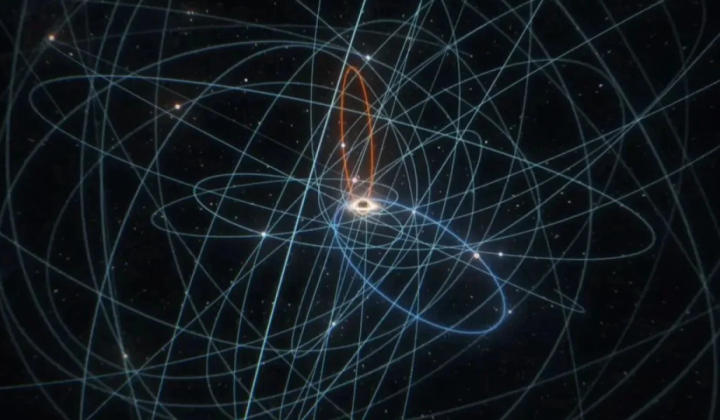
An illustration showing the orbits of all known stars at the center of the galaxy highlights S301's orbit marked in orange. This discovery could significantly expand our understanding of the dynamics of stellar systems under the influence of supermassive black holes.
The detection of star S301 and its interaction with the black hole Sagittarius A* underscores the importance of studying the dynamics of stellar systems in our galaxy. Knowledge about the orbits of stars orbiting supermassive black holes can aid in understanding fundamental physical processes occurring in such extreme conditions. Observations planned for the coming years may also provide new data for testing theories about gravity and the behavior of matter in strong gravitational fields.
In addition to the remarkable findings about star S301, recent observations by the James Webb Space Telescope have revealed intriguing water signatures around a dying star at the center of the Milky Way. This discovery sheds light on the complex interactions between stars and their environments, further enriching our understanding of cosmic phenomena. For more details on this fascinating research, check out how Webb has detected water near a dying star.

Read also