AI-Powered Search Finds a Dormant Supermassive Black Hole 30,000 Light-Years From Its Galactic Center—a First

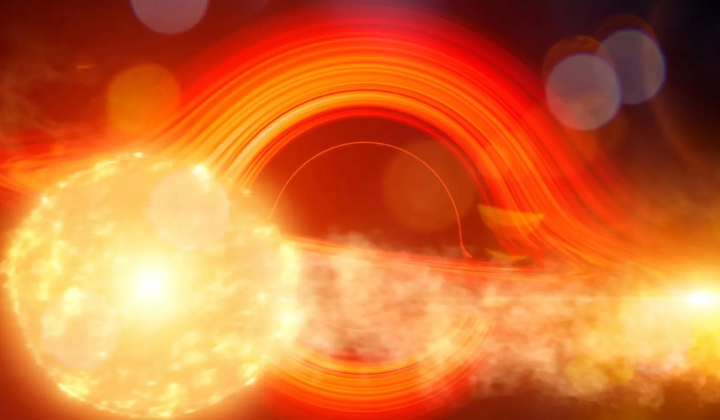
Cosmic Drama: A Star's Destruction Exposes a Rogue Supermassive Black Hole
According to НВ — Техно: Published: 6 August, 22:30
Most known supermassive black holes sit at the centers of galaxies, so a dormant one this far out is an unusual find. For the first time, astronomers have detected an inactive object of this mass so distant from a galactic nucleus. The discovery was made by a team at the University of Maryland using artificial intelligence, and the black hole lies roughly 30,000 light-years from the center of its galaxy. It revealed itself only after tearing apart a passing star, setting off a tidal disruption flare.
Wandering black holes are normally impossible to see with telescopes because they are not feeding on matter and give off no light. In this instance, the flare from the shredded star made the hidden object visible. To hunt for such occurrences, the researchers trained a machine-learning algorithm that has been continuously examining sky-scan data from the Zwicky Transient Facility since August 2025.
The object's mass is comparable to that of the supermassive black hole at the center of the Milky Way. Interestingly, there is no surrounding stellar environment around this black hole. Scientists believe its peculiar position may stem from an ancient collision between galaxies.
There are several possible reasons why this black hole ended up so far from its galaxy's core:
- A large galaxy may have swallowed a smaller one, stripping away most of the smaller galaxy's stars;
- A chaotic three-way interaction among black holes may have kicked the lightest one far beyond the core.
This case offers new opportunities for studying wandering black holes and deepens our understanding of galaxy evolution. The results are described in a paper with DOI: 10.3847/2041-8213/ae77f3.
Finding a wandering supermassive black hole is a significant milestone in astronomy, as it lets researchers examine the complex processes unfolding inside galaxies. It may also shed light on how black holes form, grow, and interact with their surroundings. The discovery demonstrates the power of modern tools such as machine learning in space research, and it may pave the way for more such discoveries in the future.
This discovery sheds light on the complexities of black hole behavior, especially as recent research indicates that black holes may not be as efficient at consuming matter as previously believed. Understanding these dynamics could provide deeper insights into the formation and evolution of such cosmic entities. For more on this topic, see how astronomers are reassessing black hole consumption rates in our detailed article exploring black hole efficiency.

Read also