Astronomers Capture Unique 'Chirp' from a Newborn Magnetar

Investigating Supernova SN 2024afav
According to НВ — Техно: An international team of astronomers has completed a study of supernova SN 2024afav, first detected in late 2024. Over more than 200 days, they used 27 telescopes to observe four distinct brightness fluctuations, which they have described as a 'chirp.' The researchers concluded that these fluctuations were caused by the birth of a magnetar, a type of neutron star.
Magnetar Properties
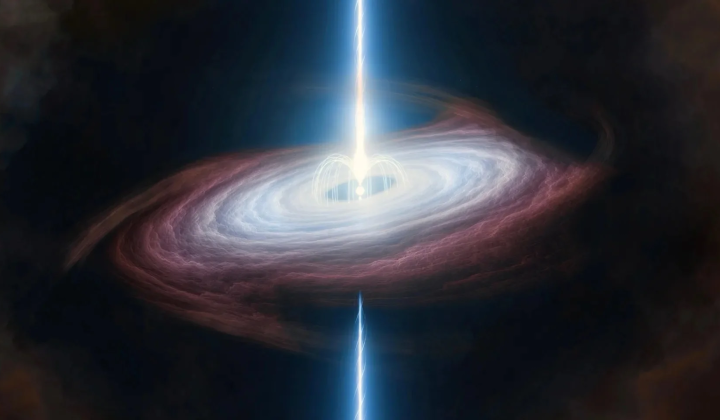
According to the data collected, the magnetar has a rotation period of roughly 4.2 milliseconds and generates a magnetic field about 300 trillion times stronger than Earth's. Scientists note that the accretion disk surrounding the magnetar wobbles due to the Lense-Thirring effect, a consequence of spacetime distortion predicted by the general theory of relativity.
Located approximately one billion light-years away, these observations of supernova SN 2024afav open new frontiers in understanding the processes involved in magnetar formation. The findings were reported by ScienceDaily in an article published on July 7. An illustration of the magnetar, surrounded by an accretion disk wobbling under the influence of general relativity, was presented in the study by researchers including Joseph Farah and Curtis McCully from Las Cumbres Observatory.
The investigation into SN 2024afav highlights the importance of modern observation technologies and the collaborative efforts of the international astronomical community in unraveling the mysteries of the universe.
This discovery is significant not only for astronomy but also for physics, as it provides new data on the extreme conditions present in space.
Studying magnetars could deepen our understanding of fundamental physical principles, such as gravity and electromagnetism, and their impact on surrounding space. Given that magnetars are rare objects, each new observation brings us closer to unraveling their nature and evolution.

Read also