The Bolsheviks' Avant-Garde: Ukrainian Artists in the Service of Propaganda and Uniform Design

Avant-Garde Artists During Ukraine's Civil War
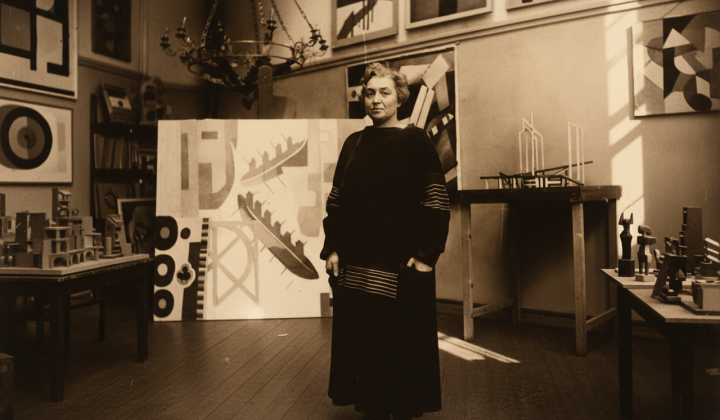
According to ХВИЛЯ: During the Ukrainian Civil War, avant-garde artists actively collaborated with the Bolshevik authorities, engaging in propaganda design and the development of military uniforms. Following the expulsion of the Ukrainian People's Republic's forces from Kyiv in 1919, Alexandra Exter and her studio began working for the new regime. This period saw a complex fusion of radical art and revolutionary politics, as artists lent their talents to the Bolshevik cause. Exter, alongside colleagues such as Bohomazov, Henke, Redko, Shifrin, and Tyshler, participated in decorating propaganda trains, notably the agit-steam locomotive named 'Pushkin'.
“Later, Exter, together with Bohomazov, Henke, Redko, Shifrin, and Tyshler, painted propaganda trains and the agit-steam locomotive 'Pushkin'.”
Serhiy Udovyik
Furthermore, Alexandra Exter contributed to designing the dress uniform for the Red Army, a point also noted by Serhiy Udovyik, who states she 'took part in creating the dress uniform for the Red Army'. During this time, Kazimir Malevich was also actively working on similar projects. In Kharkiv, the constructivist Vasyl Yermylov decorated the propaganda train 'Red Ukraine' around 1921, a significant component of the era's agitprop efforts.
“He is such a powerful constructivist figure, a Kharkiv native. He decorated the propaganda train 'Red Ukraine' around 1921.”
Serhiy Udovyik
Thus, avant-garde artists in Ukraine during the Civil War became crucial participants in the propaganda process, utilizing their talents to support the new authorities and shape the image of the Red Army.
The Interplay of Art and Politics
This era in Ukrainian history illustrates how art and politics can interact, forging new modes of expression and bolstering ideological narratives. The collaboration between artists and the Bolshevik authorities underscores the importance of cultural elements in shaping public consciousness and social identity amidst revolutionary upheaval. Propaganda projects, such as the decoration of agit-trains, not only reflected the political aspirations of the time but also served as a platform for the development of new artistic styles and movements within Ukrainian art. This work represents a pivotal, if controversial, chapter in the story of modernism's entanglement with state power.

Read also