AI Will Handle 60% of HR Tasks by 2030

What Is an AI HR Assistant?
According to AIHR: AI-powered HR assistants are becoming a key component in human resources management, leveraging artificial intelligence-especially large language models (LLMs). According to Gartner forecasts, by 2030, 60% of HR tasks will be executed through an intelligent agent or LLM interface. However, only 45% of managers believe AI implementation has improved their teams' performance as much as they expected.
Types of AI HR Assistants: Standalone vs. Embedded
AI HR assistants fall into three categories: standalone tools, those embedded in collaboration platforms like Microsoft Teams and Slack, and those integrated into Human Resource Information Systems (HRIS) such as BambooHR and Workday. Each type offers distinct advantages and capabilities.
What Can an AI HR Assistant Do? 6 Common Use Cases
AI HR assistants support a wide range of applications, including:
- HR Research and Knowledge Support – for example, AIHR Copilot uses articles, courses, and templates from AIHR.
- Employee Self-Service and Policy Queries – helping staff quickly access company policy information.
- Recruiting and Candidate Screening – such as Paradox (Olivia) handling these tasks.
- New Employee Onboarding – automating the integration process for newcomers.
- HR Service and Ticketing – like Leena AI, which streamlines employee request handling.
- HR Data, Reporting, and Document Drafting Support – assisting with data management and report preparation.
Benefits and Challenges of AI HR Assistants
Key benefits of AI HR assistants include 24/7 availability, fast response times, reduced workload for frontline HR, consistent answers to policy questions, and multilingual support. However, challenges remain, such as the risk of hallucinations, data privacy and access control issues, handling sensitive situations, implementation and maintenance efforts, and the need for employee trust and adaptation.
For organizations in the EU, it is important to assess whether their AI use cases fall under the EU AI Act.
Examples of AI HR Assistants
Notable AI HR assistants include AIHR Copilot for HR research, Ask BambooHR for HRIS-embedded service, Paradox (Olivia) as a recruiting assistant, Galileo as a standalone HR assistant, and Leena AI for HR service.
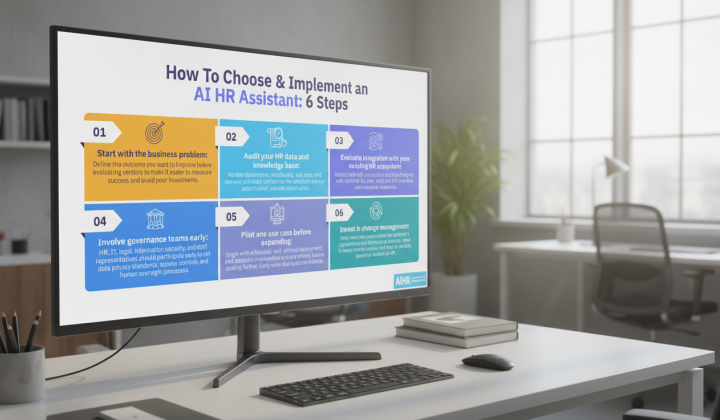
6 Steps for Selecting and Implementing an AI HR Assistant
To effectively deploy an AI HR assistant, organizations should follow these steps:
- Start with a Business Problem – identify specific tasks that need solving.
- Audit HR Data and Knowledge Base – review what data is already available.
- Evaluate Integration with Existing HR Ecosystem – ensure the new tool is compatible with current systems.
- Involve Management Teams from the Start – secure support from all stakeholders.
- Pilot One Use Case Before Scaling – test the solution on a limited basis first.
- Invest in Change Management – supporting employees through the transition is critical.
AI HR assistants can significantly reduce routine HR tasks. The greatest value comes from solving one clear problem. Reliable AI requires clean data and proper governance. It is important to remember that AI works best when combined with human judgment, not as a replacement for it.
Deploying AI HR assistants opens new opportunities for optimizing human resources processes, but it demands careful planning and attention to detail. Organizations must consider potential challenges around data privacy and the integration of new technologies into existing systems. Effectively using AI in HR can boost productivity, but striking a balance between technology and the human element is essential.
As organizations increasingly rely on AI to streamline HR processes, understanding effective implementation strategies becomes crucial. For insights on how AI can automate even more HR functions, explore our article on strategies for maximizing AI in HR. This detailed guide provides practical approaches to harnessing AI's potential in human resources.

Read also