Philippines Hands Over Island to AI Council Led by Churchill and Sun Tzu

The Sensay Island Experiment
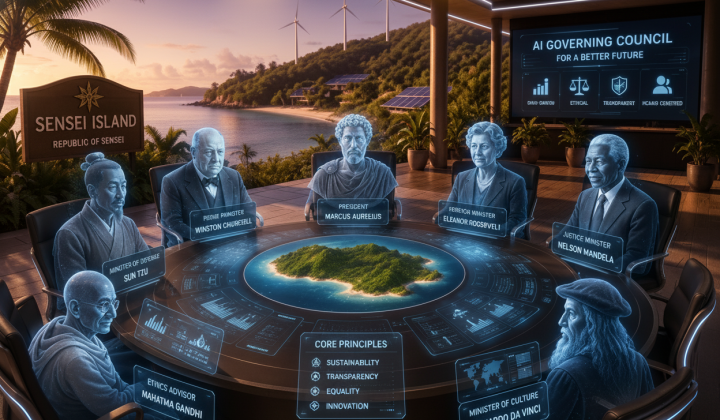
According to Главком: An ambitious pilot project is set to place the Philippine island of Sensay under the governance of an artificial intelligence council. The 3.4-square-kilometer island was purchased in 2025 by British tech entrepreneur Dan Thomson, founder of the startup Sensay, which specializes in creating digital clones of real people. The initiative will feature 17 AI agents, each modeled after a historical figure.
Council Lineup and the Role of Historical Figures
The council includes notable personalities such as Roman emperor and Stoic philosopher Marcus Aurelius, who will serve as president, and Winston Churchill, appointed as prime minister. Ancient Chinese strategist Sun Tzu has been named defense minister, while Eleanor Roosevelt will act as foreign minister. Nelson Mandela is set to be justice minister, Mahatma Gandhi will serve as ethics advisor, and Leonardo da Vinci will hold the culture portfolio.
More than 12,000 people have already applied for e-residency status on Sensay Island, reflecting strong interest in the opportunities this experiment offers. In the initial phase, the AI agents will not have the authority to implement decisions independently. To mitigate potential risks, a nine-member human assembly, elected from among the island’s residents, will be established with absolute veto power.
Currently, the island has just one inhabitant-a local gardener. During 2026, plans include building laboratories, launching autonomous green microgrids, and constructing up to 30 tech villas. These developments aim to expand infrastructure and technological capacity on Sensay.
Dan Thomson has voiced concerns about the dangers associated with these technologies, warning of threats such as 'secretly purchasing weapons and attacking neighboring Philippine islands.'
His remarks underscore the need for robust oversight and ethical safeguards in deploying cutting-edge technology. The Sensay Island project could mark a significant step in using artificial intelligence for territorial governance, but security and accountability remain critical to its success.
This experimental initiative is drawing widespread attention from both potential residents and the tech community, as it may serve as a benchmark for integrating AI into governance. Its outcome could shape future applications of artificial intelligence in public administration, while also raising new ethical and legal questions that demand careful consideration. At the same time, warnings about the potential risks of such technologies highlight the necessity of establishing clear rules and control mechanisms to prevent adverse outcomes.
The innovative governance model on Sensay Island raises questions about the future of AI in leadership roles. As this groundbreaking project unfolds, a council of AI robots governing a Philippine island showcases the potential implications of integrating technology into societal structures. This comparison highlights the evolving landscape of AI governance and its possible effects on communities worldwide.

Read also