Physicists Unveil a Novel Superionic Ice Phase Under Extreme Heat and Pressure


Exploring Superionic Ice
According to НВ — Техно: In a groundbreaking experiment, physicists have produced a previously unknown form of superionic ice by subjecting water to intense conditions: temperatures reaching 2630 K (approximately 2357 °C) and pressures of 230 gigapascals (GPa). Led by Alexis Forestier at the French Alternative Energies and Atomic Energy Commission (CEA), the team used powerful lasers to heat water samples while compressing them between the tips of ultra-hard diamond anvils. The pressure applied was about 2.3 million times higher than atmospheric pressure at sea level.
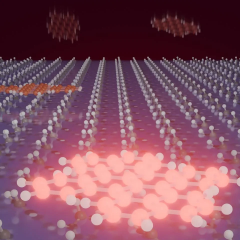
Under these extraordinary conditions, water does not vaporize but instead transforms into a superionic state. This exotic phase features a rigid crystalline lattice of oxygen atoms, within which hydrogen nuclei move freely, enabling remarkable electrical conductivity. X-ray analysis revealed that when pressure exceeds 200 GPa, the crystal structure shifts from a cubic to a hexagonal close-packed (hcp) arrangement. Astrophysicists believe that superionic ice is a major component of the mantles of ice giants like Neptune and Uranus.
Implications of the Discovery
These findings provide valuable insights for refining models of electric charge circulation within icy giant planets, offering explanations for the complex and offset magnetic fields observed on Neptune and Uranus. The precise atomic configuration identified in superionic ice opens new avenues for future experimental and theoretical studies in this field.
Understanding superionic ice is crucial for astrophysics as it sheds light on the physical processes occurring deep inside distant planets. Discovering new characteristics of this material could influence research on planetary formation and evolution, as well as inspire the development of advanced materials with unique properties for technological applications. This research contributes fundamentally to expanding our knowledge of the universe and the intricate systems within it.

Read also