US Physicists Accelerate Gold Nuclei Near Light Speed, Uncovering Unexpected Phase Transition Behavior

Exploring Nuclear Matter in the United States
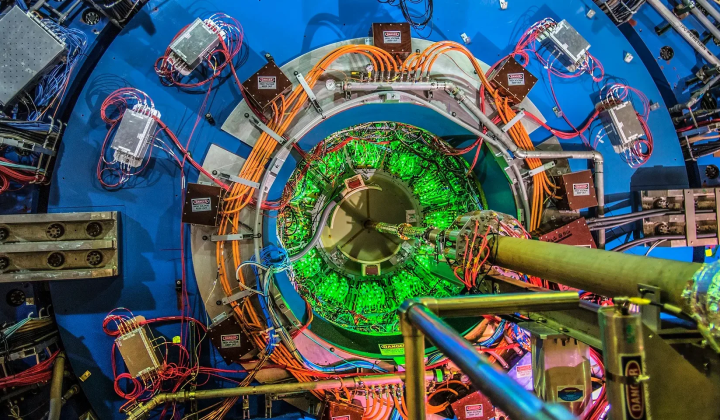
According to НВ — Техно: Using the STAR detector at the Relativistic Heavy Ion Collider (RHIC), physicists in the US propelled gold nuclei to velocities approaching the speed of light, generating one of the densest known forms of nuclear matter within a laboratory setting. During these experiments, researchers observed an anomaly that may signal the presence of a critical point in the phase transition of matter. Located at Brookhaven National Laboratory, the RHIC has operated for over 25 years and concluded its mission in early February 2026.
Experiment Details and Findings
The team analyzed collision energies ranging from 3 to nearly 8 giga-electronvolts (GeV). Within this range, they detected a pronounced dip in momentum fluctuations between 5.2 and 7.7 GeV. These fluctuations serve as a reliable indicator for gauging temperature variations in the microscopic matter clusters formed during collisions. By measuring particle momentum fluctuations, scientists can infer the temperature of the dense nuclear matter created.
At the highest RHIC energies, protons were broken down into free quarks and gluons, while at lower energies, the gold nuclei compressed to densities comparable to those found in neutron stars. However, as noted by physicist Rutik Manikandhan, this single anomaly does not definitively prove the existence of a critical point, prompting ongoing investigation and alternative interpretations. Research efforts continue as scientists aim to deepen our understanding of nuclear matter and its phase transitions.
These findings hold significant implications for nuclear physics and the behavior of matter under extreme conditions. Identifying a potential critical point in the phase transition could reveal new properties of the quark-gluon plasma formed under incredibly high temperatures and densities. Continued studies may ultimately shed light on the fundamental nature of matter and the processes that shaped the evolution of the universe.
As researchers continue to explore the complexities of nuclear matter, findings from the Relativistic Heavy Ion Collider raise intriguing questions about phase transitions. This mirrors recent discoveries by physicists in California, who have also delved into fundamental theories of the universe, such as string theory. Their work has significant implications for our understanding of cosmic phenomena, particularly following the absence of mini black holes at the LHC. To learn more about how these findings challenge existing theories, visit the latest updates on string theory.

Read also