Infinite Photon Paradox Discovered by Physicists

Findings from Professor Johannes Skaar's Research
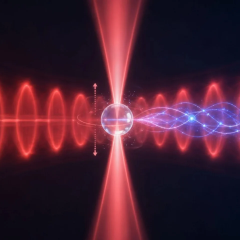
According to НВ — Техно: On June 22, 2023, at 8:00 AM, results emerged from a study led by Johannes Skaar, a professor of theoretical physics at the University of Oslo. His theoretical calculations demonstrated that when a photon passes through an ultrafast shutter-one that closes while the light wave is still moving-a complex superposition of states arises. This superposition fluctuates between zero and an infinite number of photons.
The research models a scenario where the shutter closes precisely as the light wave travels, effectively slicing off its trailing portion. According to the calculations, cutting the wave in this way generates an intricate superposition of states, where the probability of a specific number of photons depends on the shutter's speed. If the shutter closes instantaneously, the expected photon count becomes infinite.
Paradoxical Outcomes and Their Implications
Local measurements taken on one side of the shutter detect a single photon, while the opposite side registers a perfect vacuum. This suggests that, on a global scale, the system exists in a paradoxical mixed state. The new theory outlined in the study establishes a clear cause-and-effect sequence for microscopic interactions.
“These results could have major implications for the advancement of quantum physics, particularly in technologies related to quantum computing and communications.” - Professor Johannes Skaar
The research findings have been accepted for publication in the journal Physical Review Letters. Looking ahead, the scientists plan to test the mechanism with other quantum particles, such as electrons. Given that photons are indivisible quanta of light, the authors based their work on the principle of wave-particle duality, which holds that a photon behaves both as a particle and a wave.
Professor Skaar's study opens up new avenues for understanding quantum processes and could drive further progress in quantum mechanics theory, underscoring the need for experimental verification of theoretical predictions.
The exploration of quantum phenomena continues to yield fascinating insights, as evidenced by recent advancements such as the recreation of Schrödinger's cat experiment by physicists at Oxford. Their work with trapped ions highlights the complexities of quantum superposition, paralleling the intriguing findings of Professor Skaar's research. Both studies deepen our understanding of the quantum realm and its potential applications.

Read also