One of the Brightest Gamma-Ray Bursts in Two Decades, GRB 260310A, Surprises Scientists with Late Brightening

Investigating the Gamma-Ray Burst GRB 260310A
According to НВ — Техно: On March 10, 2026, NASA’s Fermi space telescope detected the gamma-ray burst GRB 260310A. Initially lasting about 53 seconds and appearing relatively faint, the event soon revealed itself as one of the most luminous bursts recorded in the past 20 years. Remarkably, the visible light emitted by the explosion outshone its entire host galaxy. The burst’s X-ray and optical emissions ranked among the top 1% brightest ever observed, while its radio waves placed it within the top 5% in intensity.
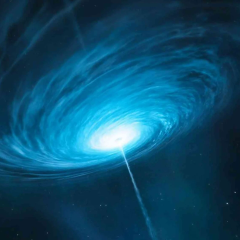
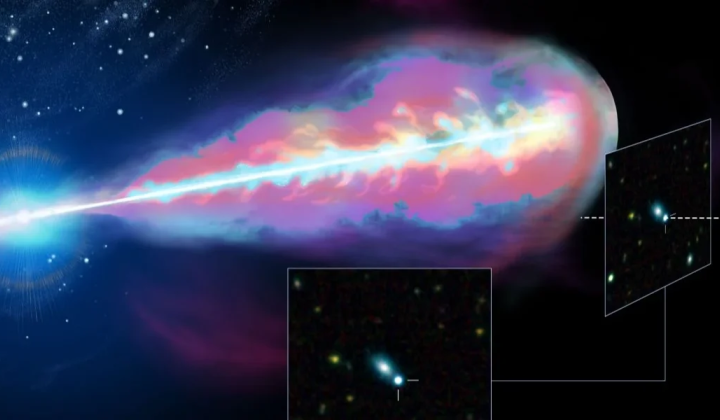
Unexpectedly, around three weeks after the initial explosion, the X-ray signal intensified and remained unusually bright for over a week. Scientists continued monitoring the source’s X-ray output for several months. Gamma-ray bursts occur during the catastrophic collapse of massive stars, which produce narrow jets of material traveling near light speed. The brightest bursts are usually seen when these jets point almost directly at Earth. However, in the case of GRB 260310A, astronomers believe the jet was observed from an angle, causing the most energetic core to be hidden from direct view.
Observations and Key Findings
The jet likely consisted of a highly energetic, narrow inner core surrounded by a broader, slower outer layer. Early observations captured mainly the outer jet regions visible from Earth. As the jet slowed down and its emissions spread to wider angles, the inner core’s light became detectable. As researcher Yu-Han Yan explained,
"Like a flashlight beam, the jet appears brightest when viewed head-on. Most models are based on such direct observations. This burst allowed us to see beyond that bright center."
The study was led by an international team from the BHianca group at the University of Rome Tor Vergata. They combined data from multiple sources, including the Chandra and XMM-Newton X-ray observatories, the Einstein Probe mission, the Large Binocular Telescope, and the Karl G. Jansky Very Large Array radio telescope. Additionally, the Calar Alto Observatory detected signs of a supernova linked to the burst. Model estimates suggest the jet’s narrow core emitted an amount of energy comparable to what the Sun produces over approximately one billion years.
These findings open the door to uncovering other hidden stellar explosions. Yu-Han Yan noted,
"At first, I suspected another X-ray source was influencing our data. But it became clear that the late brightening originated from the burst’s afterglow."
Upcoming wide-field sky surveys, such as those planned with the Vera Rubin Observatory, will be crucial for discovering more such events, expanding our understanding of cosmic phenomena.
The research on GRB 260310A highlights the critical role of multi-wavelength observations in deciphering complex cosmic explosions. Insights gained from this event may improve techniques for detecting and analyzing powerful bursts, enhancing knowledge about star life cycles and their deaths. These advancements also hold promise for future astronomical studies, particularly regarding dark matter and galaxy evolution.
As scientists continue to analyze the intriguing properties of GRB 260310A, similar phenomena are being investigated, such as the recent observations made by the Einstein space probe. This probe has unveiled extended soft X-ray emissions following a neutron star collision, providing further insights into the violent events occurring in our universe. For more details on this fascinating discovery, visit the extended X-ray emissions observed after a neutron star collision.

Read also