Harvard Develops Lithium Niobate Photonic Chip Delivering 4.2 mW Ultraviolet Light—120 Times More Powerful

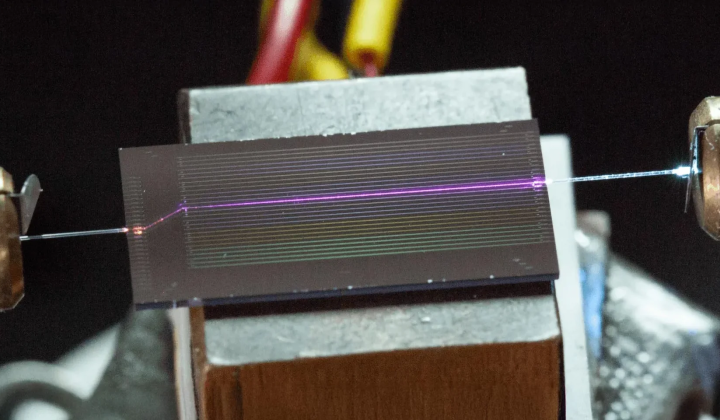
Harvard's Breakthrough in Photonic Chip Technology
According to НВ — Техно: Scientists at Harvard University have engineered a compact photonic chip made from lithium niobate that emits ultraviolet light at 390 nanometers with an output power of 4.2 milliwatts. This achievement marks a 120-fold increase in power compared to earlier lithium niobate-based devices. Such advancement holds promise for drastically reducing the size of quantum computers and enhancing the precision of atomic clocks and environmental sensors.
Innovative Design and Manufacturing Techniques
The chip is fabricated using a thin lithium niobate film and operates through a frequency up-conversion process, where two photons of red light combine to form a single ultraviolet photon. A novel "sidewall poling" method was employed, involving metal electrodes positioned adjacent to the optical channel with fabrication precision around 50 nanometers. This meticulous engineering significantly boosts the chip's efficiency.
This cutting-edge technology offers substantial potential for applications in quantum computing, particularly those relying on trapped ions. Additionally, it can be used to build highly compact and accurate atomic clocks as well as sensors designed to monitor environmental conditions. Devices based on this chip can detect greenhouse gas concentrations and other atmospheric pollutants, representing an important tool in addressing climate change challenges.
The development of this photonic chip opens new avenues for advancements in scientific and industrial technologies. If successfully integrated, these miniaturized systems could revolutionize computational methods and environmental monitoring, ultimately benefiting society at large. Continued research may unlock further innovations in both quantum physics and ecological instrumentation.
This breakthrough in lithium niobate technology closely parallels recent advancements in materials science, such as the discovery of niobium phosphide nanoribbons by Stanford engineers. These nanoribbons exhibit superior conductivity compared to copper at room temperature, highlighting the ongoing evolution of materials that could enhance the efficiency and performance of future electronic devices.

Read also