Massive Cold Zone Near Greenland Expands to 2.5 Million km² as Temperatures Drop by 1 Degree

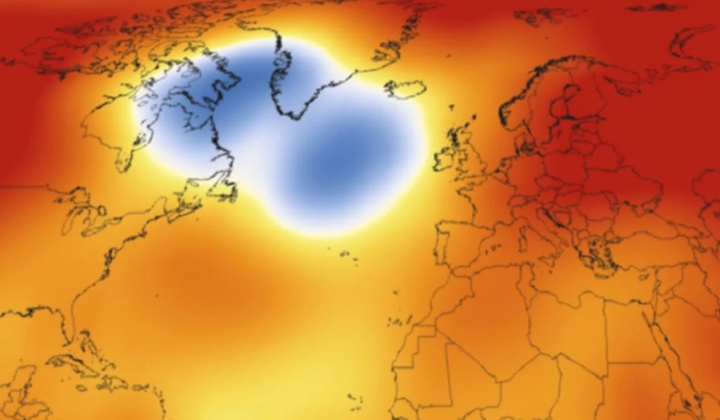
Unusual Cooling Amid Greenland's Waters
According to НВ — Техно: For over a century, a vast cold region covering roughly 2.5 million square kilometers has persisted south of Greenland, where water temperatures have decreased by about 1 degree Celsius. This cooling trend occurs despite the ongoing global warming. Researchers from Pennsylvania State University have identified that this temperature decline unfolds in three distinct phases linked to shifts in the Atlantic Meridional Overturning Circulation (AMOC), a crucial component of the Gulf Stream system. Their findings were published in the journal Nature Communications.
Phases of the Cooling Process
The cooling pattern in this area progresses through three stages:
- The initial phase involves a slight temperature drop coinciding with a weakening of ocean currents.
- During the second phase, the rate of cooling triples, and the cold zone expands into the subpolar basin.
- In the third phase, the cooling trend slows down and the cold anomaly shifts northeastward, influenced significantly by reduced cloud cover and atmospheric heat radiation.
Climate models predict that by 2100, the AMOC could reach its weakest state since records began, though a complete halt of these currents is unlikely to happen suddenly. This gradual weakening is expected to increase weather variability and lead to harsher winters across Europe and North America. As one scientist explained,
“the ocean will start absorbing heat from the air in a fundamentally different way than it does today,”
which may have profound effects on regional and global climate patterns.
These insights highlight the complexity of climate systems and their far-reaching impact on global weather. The persistent cooling near Greenland serves as a critical indicator of ongoing shifts in atmospheric and oceanic circulation, potentially triggering significant ecological and economic consequences. Understanding such anomalies is essential for improving climate forecasts and developing effective adaptation strategies worldwide.
The implications of these cooling trends extend beyond Greenland, as they may influence broader climatic patterns. For instance, recent revisions in climate models suggest that the Arctic could see a significant reduction in winter sea ice, potentially losing up to one million square kilometers. Understanding these interconnections is crucial for grasping the full impact of changing climates. To explore this further, read about the potential shrinkage of Arctic winter sea ice and its implications.

Read also