HR Certification Won't Land You a Job, but It Can Boost Your Salary by 15%

The Real Value of HR Certifications
According to AIHR: For professionals entering the human resources field, certifications can offer a useful edge-especially early in a career. However, they are by no means a guarantee of employment. Employers tend to prioritize a candidate's hands-on skills, relevant experience, and overall fit for a specific role over certification alone. While a credential might help a resume get past initial screening filters, practical abilities ultimately carry more weight in securing a position.
According to data from SHRM, HR professionals who hold a SHRM certification report earning salaries that are 14–15% higher than those without it. Notably, the aPHR (Associate Professional in Human Resources) credential from HRCI does not require any prior HR work experience-only a high school diploma or equivalent. In contrast, the PHR (Professional in Human Resources) from HRCI demands proven professional experience in the field.
The SHRM-CP certification has no prerequisites for prior work experience or a diploma, though a foundational understanding of HR is recommended. The Academy to Innovate HR (AIHR) is recognized by major associations including SHRM, HRCI, HRPA, CPHR, ATD, and CIPD, and is also approved by SHRM to offer Professional Development Credits (PDCs). AIHR’s HR Coordinator Certificate Program is another option that requires no prior HR experience.
Key Takeaways
The analysis clearly shows that certifications provide the greatest advantage at the start of an HR career, but they are not a ticket to a job. The right choice often depends on where someone is in their professional journey. A certification can grab an employer’s attention, but practical know-how remains the deciding factor for successful hiring.
Certification proves most valuable in scenarios such as:
- entering HR with no prior experience;
- transitioning into HR from another career;
- applying for HR assistant or coordinator roles;
- working in HR without certification and aiming for a promotion or a more strategic position.
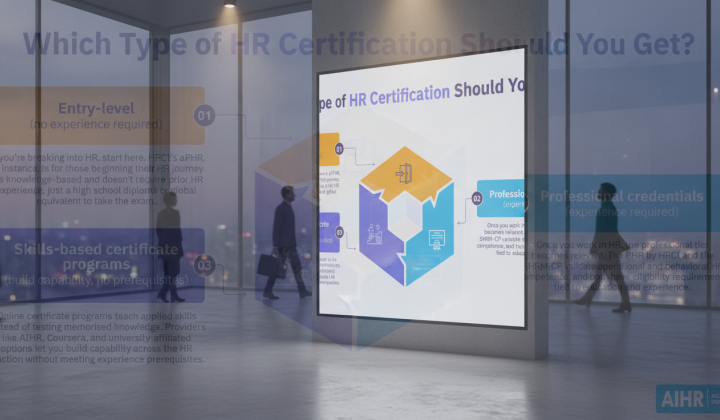
HR certifications generally fall into three categories: entry-level credentials like the aPHR, professional certifications such as the PHR and SHRM-CP, and skill-based certificate programs offered by AIHR.
Having a certification can streamline the job search in several ways: it helps resumes get past automated filters, confirms knowledge not yet reflected in work history, demonstrates commitment to the HR field, and is linked to higher pay. Additionally, it provides tangible proof of a candidate’s competence.
Given these facts, it is clear that HR certifications can be powerful tools for those at the beginning of their careers in this field-but they cannot replace real-world experience. Candidates must recognize the importance of combining credentials with practical skills to improve their chances of successful employment. In an increasingly competitive job market, understanding the different types of certifications and their requirements can be decisive in choosing the best path for career growth in HR.
As you consider the impact of certifications on your HR career, it's also important to evaluate the differences between options like the PHR and SHRM-CP. Understanding these distinctions can help you make an informed decision that aligns with your professional goals. For a deeper dive into which certification may best suit your needs, check out our detailed comparison of HR certification options.

Read also