A Robot with 20 Legs and Cameras Named Argus Has Been Developed by Engineers

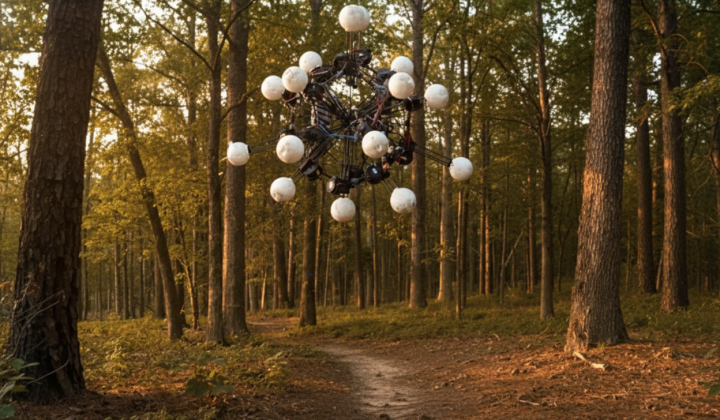
Duke University Unveils the Argus Robot Prototype
According to Главком: Researchers at Duke University in the United States have built a prototype robot called Argus, featuring a spherical body and 20 telescopic legs, each equipped with high-precision cameras. Named after the many-eyed giant from ancient Greek mythology, this robot has shown remarkable stability and obstacle-crossing abilities during tests. Its design is rooted in mathematical principles, specifically a regular dodecahedron composed of 12 pentagonal faces. The robot achieves an isotropy index of 0.91-a significant leap compared to most modern wheeled or legged robots, which typically score just above 0.6. This index measures how uniformly a robot can apply force in any direction, making it a key indicator of agility and balance.
Testing and Capabilities of Argus
During trials, Argus successfully navigated various terrains, including thick grass, deep sand, concrete, and wet tree bark. It can clear barriers up to 12.7 centimeters high and confidently ram and push aside large objects. Notably, the robot continued to perform tasks and maintain its course even after several of its legs were deliberately damaged. Each leg costs roughly $300 to produce, and the robot can carry loads of up to 4.5 kilograms.
To achieve these results, the engineering team conducted over 1,500 computer simulations of different geometric shapes, focusing on the critical parameter of dynamic isotropy. This robot exemplifies cutting-edge robotics technology with potential applications in fields such as exploration and search-and-rescue operations.
The development of the Argus robot highlights important advances in robotics that could significantly change how routine tasks are carried out in challenging environments.
Thanks to its versatility and resilience, Argus could become an indispensable tool in rescue missions, where overcoming diverse obstacles and adapting to changing conditions is crucial. It also represents progress in using mathematical models to enhance real-world robot functionality.

Read also