Iran's Strait of Hormuz Blockade: Global Economic and Military Implications

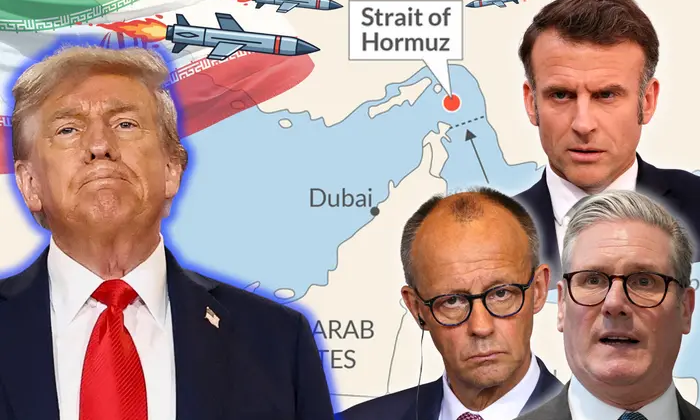
Military Tensions Escalate Between U.S., Israel, and Iran
According to Главком: The military standoff between the United States, Israel, and Iran is intensifying. The U.S. Department of Defense has requested over $200 billion from the White House to fund potential operations against Iran. Amidst this rising tension, President Donald Trump is considering deploying thousands of U.S. troops to the Middle East. This conflict is a significant escalation of long-standing regional hostilities.
In response, Iran is blockading the strategic Strait of Hormuz using multiple tactics, including speedboats, sea mines, Shahed-type drones, and missiles. This critical waterway links the Gulf of Oman with the Persian Gulf and is a vital global chokepoint, handling approximately 20–25% of the world's seaborne oil and 20% of its liquefied natural gas. Currently, the passage of over a thousand cargo ships, primarily oil and gas tankers, has been halted. Some transit routes pass as close as 5-7 kilometers from the Iranian coastline.
European Nations' Stance
In January, the U.S. decommissioned four Avenger-class mine countermeasure ships, while four others of the same class are deployed in the Pacific theater. The position of European countries on the situation remains ambiguous. As Friedrich Merz stated:
"The United States and Israel did not consult with us before this war. There was never a joint decision on Iran. Therefore, the question of what military contribution Germany will make does not arise. We will not do it." - Friedrich Merz
In turn, Dutch Prime Minister Mark Rutte emphasized that "it is clear that NATO as such is not involved here. Allies from NATO are providing key support."
European nations possess the technical capability to assist in clearing the Strait of Hormuz:
- Denmark has Iver Huitfeldt-class frigates
- France – FREMM-class frigates
- Belgium and the Netherlands – City/Vlissingen-class vessels
- Belgium has hunter-killer drones (AUVs)
- The United Kingdom and Norway are building a joint fleet of at least 13 ships with modular systems
However, Europe's reluctance to help is clearly defined by several factors: "Europeans did not want this war; this is not a NATO mission; Europeans do not think it will work; and if it does work – it could prolong the war."
The regional crisis carries significant economic consequences. Goldman Sachs has raised the probability of a U.S. recession next year to 25%. According to the New York Times, U.S. strategic miscalculations regarding Iran include underestimating the difficulty of regime change, uncertainty over how to prevent Iran from becoming a nuclear power, and the economic shockwaves from a Strait of Hormuz blockade.
Responding to the potential military fallout, Trump stated:
"If for any reason the mines (in the Strait of Hormuz) are laid and not immediately removed, the military consequences for Iran will be unprecedented… It will become practically impossible for Iran to ever rebuild as a nation. Death, Fire, and Fury will reign over them." - Donald Trump
In this complex situation, the future of the conflict remains uncertain, and the world is watching events unfold. The disruption of such a crucial shipping lane directly threatens global energy security and supply chains.
The escalating conflict between the U.S., Israel, and Iran has serious repercussions not only for the region but for the world economy, as the blockade of the Strait of Hormuz could trigger a spike in oil prices and negatively impact global markets. Although European countries have the technical means to support mine-clearing operations, they are demonstrating caution regarding military involvement, stressing that this is not their war and seeking to avoid further escalation. The situation remains tense, and future developments will depend on decisions made by world leaders.
As tensions rise in the Middle East, it's essential to understand the broader implications of America's current stance on Iran. The ongoing conflict has left the U.S. in a precarious position, often leading to diplomatic isolation and a stalemate situation. To explore how these developments have shaped the current geopolitical landscape, read more about America's diplomatic challenges regarding Iran.

Read also