The cash register is closed: why Europe hit the brakes on Ukraine's eurointegration
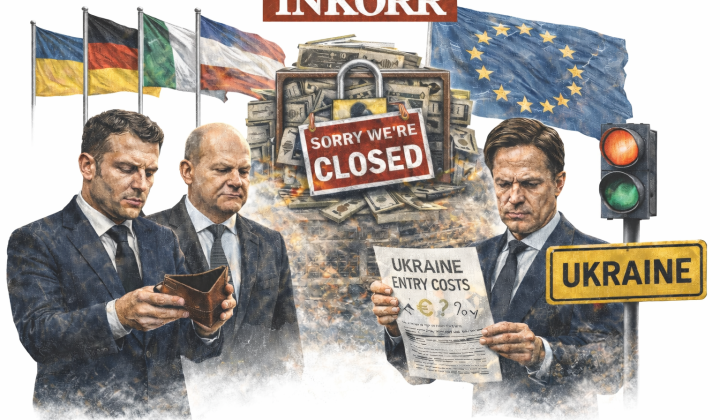
According to insights from Politico, France, Germany, Italy, and the Netherlands have united against the accelerated accession of Ukraine to the EU. A group of donor countries insists that Kyiv must go through all the established long-term bureaucratic procedures, categorically rejecting any political concessions.
The publication by Politico is not a matter of a lack of democracy or problems with anti-corruption reforms in Ukraine. It's a question of an empty cash register. The core of the European Union has adopted a regime of strict financial protectionism because 'Old Europe' simply has no money to pay for expansion.
1) Macroeconomic deadlock: expansion as financial suicide
First of all, the macroeconomic deadlock. The EU locomotive - Germany - is in systemic stagnation, losing industry, while France is trying to patch up gigantic holes in the national budget. In a situation where the European economy is balancing on the brink of recession, taking on a huge, war-damaged country with colossal reconstruction needs is financial suicide. There are no free hundreds of billions of euros in Brussels for a conditional 'Marshall Plan 2.0'.
2) Domestic electorate: who will pay for the 'project in the East'
Secondly, the domestic electorate. Any accelerated accession of Ukraine means an immediate review of the EU budget. For a French farmer, this guarantees a cut in agricultural subsidies (CAP), which will go to a Ukrainian agroholding. For a German citizen, this means higher taxes to finance European equalization funds. Neither Merz nor Macron will go to their economically struggling voters with a proposal to tighten their belts for a geopolitical project in the East. In times of crisis, one's own shirt is always closer to the body.
3) Institutional facade: bureaucracy as a smokescreen
Thirdly, the institutional facade. The demands for ideal legislation and structural reforms are an ideal smokescreen. It is much more convenient for Brussels to marinate a candidate in the 'waiting room' for years, citing shortcomings in the judicial system, than to honestly admit: the bank is closed, there is no money.
Conclusion: the 'turbo mode' crashed into accounting
The political romance of the 'exclusive turbo mode' has crashed into harsh accounting. The EU is primarily a closed economic cartel. The refusal of accelerated membership is dictated not by a lack of solidarity, but by the instinct of financial self-preservation of the EU core. For Kyiv, this means a transition to a long, exhausting, and sluggish reality where the timeline for accession will depend not on loud declarations but on when there will be free money again in the budgets of Berlin and Paris.

Read also