China and Russia Finalize Three-Tier Plan to Counter Starlink

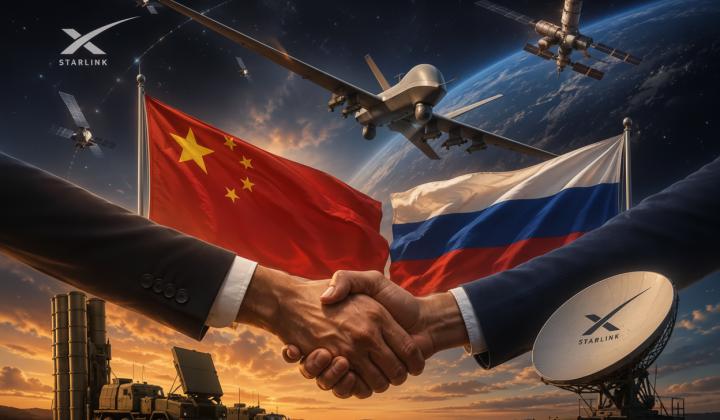
Joint China-Russia Strategy Targets Starlink
According to Главком: In November 2023, Beijing and Moscow agreed on a collaborative initiative aimed at countering SpaceX's Starlink satellite network. The plan outlines measures ranging from diplomatic pressure to the physical destruction of satellites. As part of the agreement, both nations committed to developing a shared air defense and missile defense system, along with exchanging technology in drones, armored vehicles, and aviation. This information emerged from a joint investigation by The Insider, Der Spiegel, and Le Monde, which examined documents from the Third China-Russia Forum on Military-Technical Cooperation in Guangzhou and a signed protocol from Moscow.
Three-Level Plan to Neutralize Starlink
According to the findings, engineers from China's CASC corporation presented a three-tier strategy to counter Starlink:
- The first level involves coordinated diplomatic pressure on international regulatory bodies.
- The second level includes blocking Starlink's access to frequency bands and orbital positions, as well as developing signal jamming systems.
- The third level calls for physically destroying satellites through cyberattacks and the use of low-cost weaponry.
Additionally, NATO intelligence has observed Russia working on area-effect anti-satellite weapons. Sources indicate that five months before the Guangzhou forum, a Chinese delegation spent nine days in Moscow negotiating with the manufacturer Almaz-Antey. On June 5, 2023, a ten-page summary was signed outlining joint development of an air and missile defense system, with agreed technical specifications including the interception of medium-range missiles up to 4,000 km, targets with lateral acceleration up to 25 g, and hypersonic missiles at altitudes up to 40 km.
The first phase of the air and missile defense program focuses on joint development of dual-use rocket technologies. The partnership operates on an exchange formula: Russian combat experience for Chinese technology. Beijing offers Moscow innovations in artificial intelligence and mass production for swarming loitering munitions. According to Ukrainian military intelligence, the V2U drone uses Chinese AI modules, lidar, batteries, and storage units.
The joint air defense system is expected to be operational by around 2030. The next classified military-technical cooperation forum is scheduled for late 2026 in St. Petersburg. Meanwhile, Russia is independently developing its own satellite network, Rassvet, with the first 16 units already in orbit. For full functionality, Rassvet requires 200 to 250 satellites.
'Starlink is currently the lifeblood of our entire communications infrastructure,' said Mykhailo Fedorov, then Ukraine's Minister of Digital Transformation and now its Minister of Defense.
This agreement between China and Russia underscores the deepening of their military-technical ties, a development of strategic importance amid rising global political tensions. The integration of advanced technologies, particularly in air and missile defense, could shift the regional balance of power. Furthermore, Russia's push to develop its own satellite network highlights its intent to reduce reliance on foreign technology and strengthen its defense capabilities.
The recent collaboration between China and Russia is not an isolated event; it follows earlier discussions where both nations formulated a comprehensive strategy to undermine Starlink's operations. This earlier plan highlights the urgency of their joint efforts and the multifaceted approach they are taking. For a deeper understanding of how these strategic initiatives are evolving, you can read more about their drafted approach to dismantle Starlink here.

Read also