Chinese Researchers Extend Quantum Entanglement Lifespan by 240 Times at Room Temperature

Breakthrough in Quantum Technology
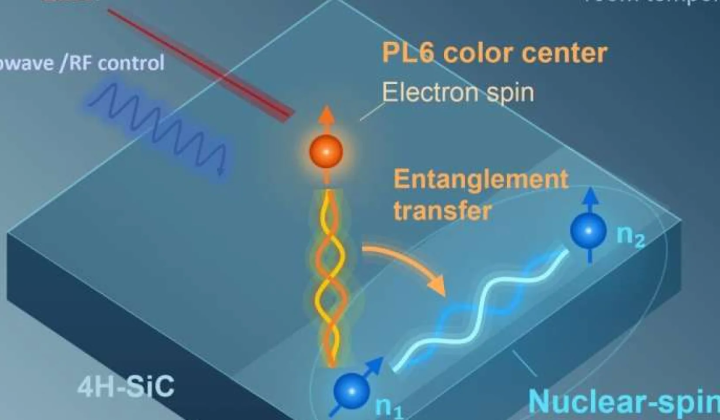
According to НВ — Техно: A team from the University of Science and Technology of China, led by Shuo Ren and Rui-Jian Lian, has made a remarkable advancement in quantum science. They successfully prolonged the coherence time of electron quantum entanglement in a solid-state system at room temperature by a factor of 240. This was accomplished by transferring entangled states from electron spins to nuclear spins of silicon-29 within silicon carbide. Their findings were published in the journal Physical Review Letters.
The initial entangled state was prepared with a high fidelity of 94%. After transferring to the nuclear spins, fidelity slightly decreased to 92.5%. Notably, the entanglement lifetime in the nuclear spin memory exceeded 240 microseconds, compared to just over 1 microsecond for electronic entanglement. Out of 200 examined centers in silicon carbide, more than 10% contained coupled nuclear spins, highlighting the material's promise for further quantum research.
Research Techniques and Implications
The team employed a specialized SWAP-gate protocol to shift quantum entanglement. Silicon carbide was selected as the solid-state platform due to its color centers, with silicon-29 nuclear spins demonstrating greater resilience against environmental noise. Quantum entanglement-where the states of two or more particles remain intrinsically linked regardless of distance-holds key potential for scaling quantum registers in emerging technologies.
This breakthrough is significant for advancing quantum computing and quantum communication. Maintaining entanglement at room temperature simplifies practical deployment by eliminating the need for complex cooling systems, a major hurdle for commercial quantum devices. Continued exploration in this area could pave the way for robust quantum networks and processors, opening new frontiers in information processing.
This advancement in quantum entanglement aligns with recent developments in quantum computing, such as the progress of the Quantinuum H2 quantum computer in the UK, which has also pushed the boundaries of classical computing capabilities. As researchers continue to explore these innovations, the potential for practical applications in quantum technology becomes increasingly promising.

Read also