China’s Type 004 Aircraft Carrier Surpasses USS Gerald R. Ford in Length, Commissioning of Fujian Confirmed

China’s Latest Aircraft Carrier Developments
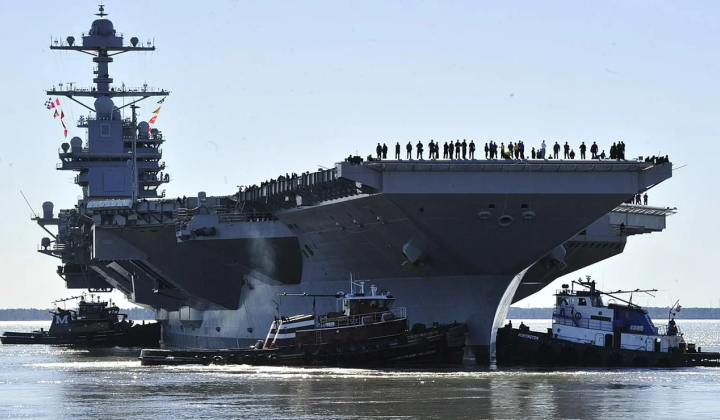
According to НВ — Техно: Recent satellite imagery reveals that China’s new Type 004 aircraft carrier measures between 336 and 339 meters, making it longer than the U.S. Navy’s USS Gerald R. Ford, which is 333 meters in length. This new vessel stretches roughly 20 meters beyond its predecessor, the Fujian aircraft carrier. Its air wing is expected to house between 75 and 90 aircraft, a significant increase from the Fujian’s estimated complement of 50 to 60 planes.
The size of the Type 004 strongly supports earlier speculation that it will be powered by a nuclear propulsion system. Such a reactor could dramatically enhance the vessel’s endurance, speed, and overall operational capabilities. The carrier’s operational range will depend on the reactor’s specifications, fuel tank capacity, and the stocks of fuel and munitions available for both its air wing and escort ships.
Fleet Expansion and the Fujian Carrier
China is actively expanding its support fleet, a key move to sustain its growing carrier groups. In July 2023, a new auxiliary vessel was launched at the Comec Longxue shipyard near Guangzhou. This support ship measures approximately 271 meters in length and 37 meters in width and is an enlarged version of the Type 901 fast replenishment ship. The first of these vessels was launched between July 9 and 12, 2023, with construction of a second ship underway as of September 15, 2023. Over several years, China has steadily increased its replenishment fleet and regularly conducts at-sea resupply drills.
On November 5, 2025, the Fujian aircraft carrier was officially commissioned at the port of Sanya on Hainan Island. The ceremony was attended by Chinese leader Xi Jinping, senior admirals, and roughly 2,000 navy personnel and industry representatives involved in the ship’s construction. The Fujian’s deck features stealth fighters like the J-35, upgraded J-15T carrier-based fighters, and KJ-600 airborne early warning aircraft. Notably, the Fujian is equipped with electromagnetic catapults to launch its aircraft, marking a major advancement in China’s naval aviation technology.
Lyle Goldstein highlighted the significance of the potential 75-90 aircraft air wing, noting that “nuclear propulsion could represent a major leap forward in the development of China’s aircraft carrier capabilities.”
These developments underscore China’s rapid naval modernization efforts aimed at reinforcing its global maritime presence.
China’s expanding naval fleet, especially its new aircraft carriers, strengthens its strategic reach regionally and worldwide. Amid escalating competition with the United States, enhancing naval power may reshape global military and political dynamics. Furthermore, investments in support vessels reflect China’s commitment to maintaining high operational readiness for its naval forces.

Read also