NASA’s Hubble and James Webb Telescopes Capture Striking Images of the Cat-Head Nebula

Remarkable Views of the Cat-Head Nebula
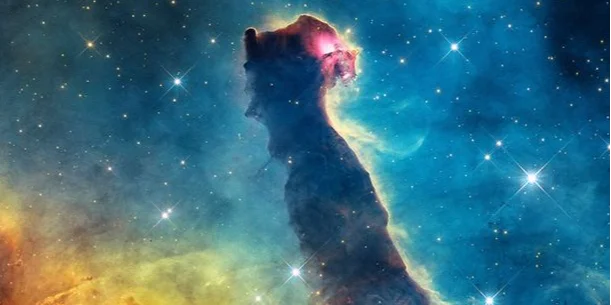
According to НВ — Техно: On November 2, 2023, NASA’s space observatories Hubble and James Webb unveiled extraordinary images of the Kiel Nebula, popularly nicknamed the 'Cat Head.' Located about 7,500 light-years from Earth, this nebula is nestled within an active star-forming region. By capturing data across multiple wavelengths, the telescopes revealed intricate details of the nebula’s dust, gas, and young stars, offering valuable insights into stellar birth processes.
Details Revealed by Hubble and Webb
Hubble’s visible-light imagery highlights a dark brown central pillar of dust, featuring a distinct reddish spot that is likely a young star partially obscured by surrounding dust. Along the edges, a yellowish glow marks ionized gas energized by ultraviolet radiation. This effect, known as photoevaporation, involves the gradual erosion of material driven by intense radiation.
Meanwhile, James Webb’s observations in the near- and mid-infrared spectrum uncovered complex dust and gas formations, dense clusters of stars, and faint background galaxies. The mid-infrared view reveals delicate filaments and dust-gas structures situated to the left of the main dust pillar. On the right side, a bright luminous source, probably another young star embedded within dust, stands out.
Combining the complementary data from both telescopes allows astronomers to deepen their understanding of how stars form and how their radiation influences their surroundings. The images were processed by Joseph DePasquale at the Space Telescope Science Institute (STScI) and were produced with support from NASA, the European Space Agency (ESA), and STScI.
These fresh observations of the Kiel Nebula open new avenues for investigating star formation, especially the interaction between nascent stars and the ambient dust and gas. Gaining insight into these mechanisms is crucial for astronomy and astrophysics, as it helps clarify galaxy evolution and star formation across the cosmos. The collaboration between Hubble and James Webb underscores the power of a multi-wavelength approach in advancing our cosmic knowledge.
In addition to the captivating images of the Cat-Head Nebula, NASA has recently revealed a stunning collection of 16 images showcasing distant galaxies. This diverse set includes everything from spiral formations to dramatic stellar explosions, further highlighting the intricate beauty of our universe. To explore these remarkable visuals and understand the various phenomena occurring in deep space, check out the full story on NASA's stunning galaxy images.

Read also