James Webb Telescope Uncovers Secrets of Interstellar Comet 3I/ATLAS and Dense Atmosphere on Exoplanet TOI-561 b

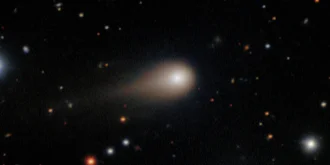
Insights into the Interstellar Comet 3I/ATLAS
According to НВ — Техно: Using the James Webb Space Telescope, astronomers have conducted detailed studies of the interstellar comet 3I/ATLAS, revealing that its water ice is intimately mixed with tiny grains of dark, rocky material. Observations were made on three occasions: August 6, 2025, December 22, 2025, and April 1, 2026, with the comet’s closest approach to the Sun occurring on October 29, 2025.
Analysis shows that the water ice within 3I/ATLAS is combined with fine particles smaller than a few micrometers, consisting of a blend of icy and refractory (heat-resistant) materials. Notably, the spectral signatures of these grains differ from those found in comets native to our Solar System, more closely resembling icy bodies located beyond Neptune.
“Interstellar comets are small frozen objects formed in the gas and dust disks surrounding other stars, now passing through our Solar System. As 3I/ATLAS heats up, gas escaping its interior carries icy and dusty particles into the surrounding coma. These grains hold clues about the conditions under which the comet originally formed.”
Dr. Silvia Protopapa
The spectral data also revealed strong water ice absorption alongside gas emissions from water vapor, carbon dioxide, and carbon monoxide. During April 2026, a second group of larger, ice-rich micron-sized grains appeared in the spectrum. Dr. Protopapa noted, “The grain sizes in 3I/ATLAS are comparable to those found in our own comets, but what sets them apart is the amount of dust mixed with the ice.”
Discovery of a Dense Atmosphere on Exoplanet TOI-561 b
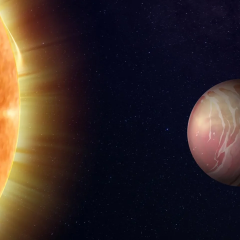
In addition to the comet study, the James Webb Telescope detected a dense atmosphere surrounding the exoplanet TOI-561 b, located approximately 280 light-years from Earth. This planet reflects about 75% of the starlight it receives. Researchers monitored nearly four complete orbits of TOI-561 b over a 37-hour period.
Evidence suggests the presence of clouds composed of silicate minerals, including silicon dioxide and magnesium silicate, enveloping the planet.
“It remains unclear whether the observed changes over time result from varying solar heating of grains during each observation or from new material being exposed as the comet’s surface erodes near the Sun. Both explanations are possible, and distinguishing between them is a key focus of our ongoing research.”
Dr. Michael Kelly
The investigation of 3I/ATLAS marks an important advance in understanding interstellar objects and their interactions with our Solar System. Exploring the composition and structure of these visitors offers valuable insights into star and planet formation in the early universe. Meanwhile, uncovering a thick atmosphere on TOI-561 b highlights the significance of studying distant planetary systems, opening new frontiers in astronomy and the search for diverse worlds.
In addition to the intriguing findings about the interstellar comet, the James Webb Telescope has also made significant discoveries regarding exoplanets. Notably, it has identified a substantial atmosphere around the rocky exoplanet TOI-561 b, which is located about 280 light-years from our planet. This revelation opens new avenues for understanding the atmospheric conditions of distant worlds, further enriching our knowledge of the universe. To explore more about this discovery, check out the full article on the dense atmosphere of TOI-561 b.

Read also