Catching the Wind with Nets. Part One
In modern architecture of global confrontation, Moscow is attempting to implement the strategy of the 'golden share'.
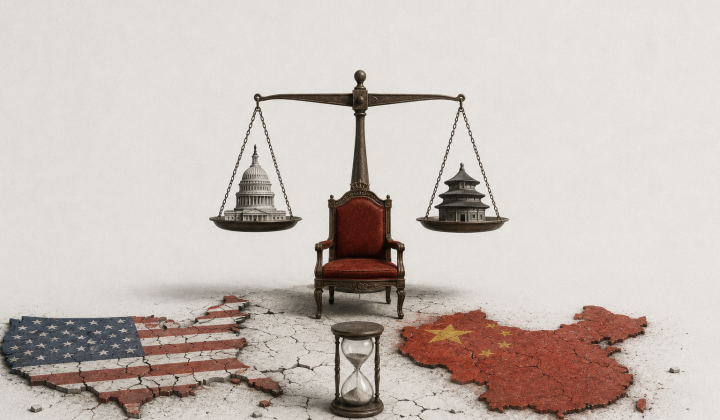
Understanding that the world has effectively split into two main poles of influence - Washington and Beijing - the Russian leadership is searching for opportunities to occupy the position of the 'third party', whose stance could tip the scales one way or another. The attempt to balance between American proposals for a deal and Chinese strategic partnership is a quest for that very extra chair at the negotiating table of the two giants, which would allow Russia to maintain its subjectivity.
However, the reality of Donald Trump's first term taught the Kremlin caution: loud statements about 'friendship' then resulted in record sanctions and deliveries of lethal weapons. Today, the situation is complicated by Russia's total structural dependence on China. The figures leave no room for maneuver: trade turnover with China has exceeded 240 billion dollars, while trade with the USA has shrunk to a statistical error. The financial system has almost completely switched to yuan, while the technological sector is 90% dependent on Chinese components.
In these conditions, the contacts between Steve Whitkoff and Kirill Dmitriev seem more like probing the ground than preparations for a real pivot. The magic of this 'developer diplomacy' may offer Moscow future investment bridges or partial unfreezing of assets, but it cannot replace the Chinese conveyor, which ensures the physical survival of the system.
For Moscow, a direct deal with Washington bypassing Beijing is now economically impossible. The Kremlin can only use these negotiations to increase its capitalization within the partnership with China, trying to bargain for itself the status of not just a junior partner but a key player with veto power.
Catching the Wind with Nets. Part Two
The central hub of the impending agreement is the fate of Donbass. Moscow is deliberately narrowing its public claims to the administrative borders of the Donetsk and Luhansk regions, pushing the questions of Zaporizhia and Kherson to the background. This is a pragmatic calculation: the Kremlin needs a 'minimally viable product' of victory, which can be quickly formalized and presented as a result. Full control over Donbass is the ideological foundation, without which it is impossible to sell the end of active actions to the internal consumer.
To fit into Washington's tight schedules, the parties are discussing a 'half-measure' option. This is no longer just a fixation along the front line, but also not a classic withdrawal of Ukrainian troops. It is about a complex hybrid scheme: the withdrawal of units can be packaged in the creation of special economic zones under international control or a model of long-term 'leasing' of territories. Legally, this will allow avoiding recognition of surrender, but in fact will transfer control over the region.
Europe, in this situation, demonstrates increasing fatigue. Continental elites in Paris and Berlin, facing economic decline and inflation, are ready to accept virtually any scenario that stops the acute phase of the conflict.
Despite public rhetoric of support, European capitals will silently agree with the American 'term sheet', fearing to be left alone with the crisis in the event of a sudden withdrawal of the USA. For them, the freeze along the lines of Trump is a way to secure losses and attempt to return to the usual economic logic, even if the price is long-term destabilization of the eastern borders.
Catching the Wind with Nets. Part Three
The main opponent of this architecture remains London. British elites, experiencing a deep systemic crisis and fragmentation of the political field, see the American-Russian deal as a direct threat to their influence in Europe. For London, any stabilization on Trump's and Putin's terms means political bankruptcy. The only chance for Britain to maintain its role as a global player is to disrupt Washington's October schedule.
London's counterplay will be focused on the southern direction and Crimea. Expect attempts to organize asymmetric strikes or large-scale incidents that will make any silence impossible. The task is to provoke an escalation after which talks about 'leasing zones' and 'economic compromises' will become toxic for the White House. For the British cabinet, an 'explosion' at the negotiating table is a matter of its own survival.
Trump's success by October largely depends on Beijing's position. Xi Jinping holds the 'pause button': he will help Trump implement a peacemaking scenario only in exchange for strategic concessions in the Pacific and on the issue of real Taiwan. The price of the deal for Trump in this case is the recognition of China's leadership in Asia in exchange for tranquility in Europe. If Beijing finds the conditions favorable, it will gently prompt Moscow towards compromise. If not, the October deadline will be missed, and Trump will face a prolonged conflict which the British will stoke with renewed vigor.
The period of the densest diplomacy is beginning, where silence is merely a way to better prepare for the next move.

Read also