Nearly a Third of New Hires Leave Within 90 Days Due to Unclear Job Roles

Why a Role and Responsibility Template Matters
According to AIHR: A well-defined roles and responsibilities template serves as a critical tool for crafting meaningful job descriptions, clarifying team duties, and communicating expectations effectively. When employees understand their specific tasks and obligations, they not only grasp their functions better but also perform more efficiently. This aligns with Vroom's expectancy theory, which suggests that people are more motivated to work hard when they believe their efforts will lead to desired outcomes. This insight is especially relevant given that almost 30% of new employees resign during their first three months on the job, with 41% of them citing a mismatch between the role and their expectations as the primary reason.
How to Define Roles and Responsibilities
Defining roles and responsibilities involves several key steps. First, it is essential to clearly outline terms such as role, duties, tasks, and skills. Clarity in job descriptions can significantly reduce turnover rates, which is vital for organizations aiming to build a stable workforce. Templates for documenting roles and responsibilities-available in formats like Word, Excel, or PowerPoint-offer different ways to capture valuable information. For instance, a Word template is flexible and user-friendly, while Excel allows for detailed tracking, and PowerPoint enables visual representation of roles.
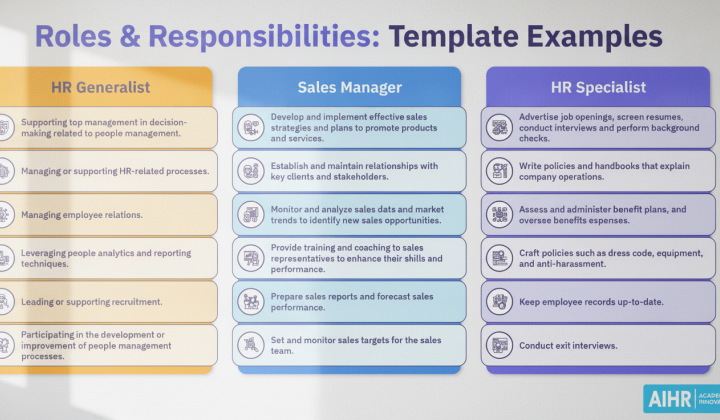
Additionally, a RACI template can be used to identify who is Responsible, Accountable, Consulted, and Informed for each project task. This approach helps prevent misunderstandings and ensures clear delegation of duties. The article also provides examples of specific roles, such as:
- HR Generalist
- HR Specialist
- Sales Manager
For example, an HR Generalist typically holds a bachelor's degree in HR or a related field and has 2–5 years of relevant experience, whereas a Sales Manager requires a bachelor's degree in business or marketing and at least 5 years of sales experience, including 2 years in a management position.
Case studies from companies like Zerotier, Preply, Slack, and Capital One illustrate how different organizations can adapt role and responsibility templates to their unique needs. Using clear, concise, and gender-neutral language in documentation, along with structured bullet points for duties and requirements, makes information easier to digest. It is also important to tailor content to reflect each role's specific aspects, avoiding assumptions that readers already know implicit tasks. Well-organized documents boost team efficiency and reduce the risk of conflicts and confusion.
Defining and documenting roles and responsibilities is crucial for businesses because it helps lower turnover and improves overall team performance. Clear instructions and customizable templates, adapted to each company's context, can significantly increase employee job satisfaction and reduce risks tied to unmet expectations. In today's fast-paced work environment, adopting such templates has become a pressing need for organizational success.
Understanding the significance of structured communication is essential for managers, especially when it comes to conducting effective one-on-one meetings. These interactions can clarify roles and enhance team dynamics, ultimately addressing the issues that lead to early employee departures. To support this, consider exploring 11 templates designed to facilitate individual meetings, which can help in defining expectations and fostering a more engaged workforce.

Read also