Mandulets: Why They Work and How to Increase Your Catch

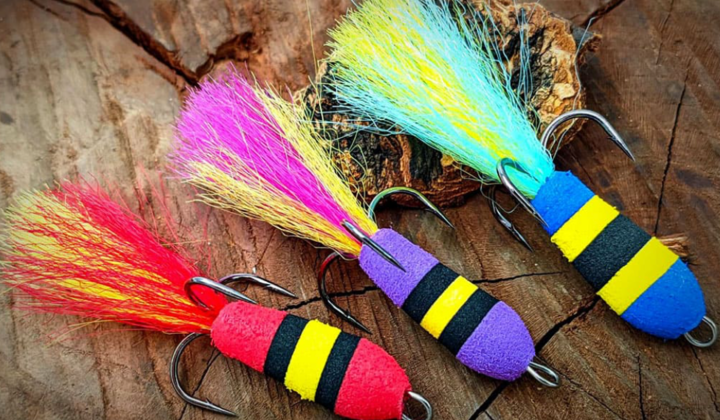
Anglers who have been fishing for many years have definitely heard of mandulets - some find the bait immediately unappealing, while others find the opposite. At first, a mandulet may seem like a strange thing: bunches of several multicolored segments, plus hooks - what’s so special about it? Initially, it seems like nothing, but once you try the bait in action, you realize: with a mandulet, there are many more bites. So why does this happen? How to use mandulets so that they really help you become more successful? Let’s figure it out.
What are mandulets and how are they designed
A mandulet is an artificial bait made up of several soft foam segments painted in bright colors. Externally, it may resemble a toy or some kind of nonsensical homemade object, but its essence is revealed in the water. These segments move independently of each other, and because of this, the mandulet, when retrieved, looks like an injured fish, which always attracts predatory fish. It is also important to note that it is best to buy mandulets from popular and trusted stores, for example on the Rybolov-Expert website.
- Why bright colors? It’s simple - they help fish notice the bait even in murky water. For instance, when fish are hunting in conditions of poor visibility, such bright contrasting colors help the bait stand out. Combinations like black with yellow or red with white are often used - these are the combinations that fish see best.
- The buoyancy of the mandulet is another strong point. It doesn’t sink instantly to the bottom, like most metal lures, but slowly hovers in the water, imitating live prey. The treble hooks located at the front and rear of the bait ensure reliable hooking of the fish.
How the mandulet attracts predatory fish
The question: why mandulet and not some other bait? The answer lies in how it behaves in the water. Predatory fish, whether it's pike, perch or zander, are always looking for easy prey. It is difficult for an angler to deceive them - a predator needs movement that seems natural and provokes an attack. That’s where the mandulet shows itself at its best. Due to its multi-segmented design, the mandulet moves chaotically, creating the impression that it is an injured or weakened fish. And as is known, predators love to pounce on such “victims”. Moreover, as the mandulet passes through the water, it creates vibrations that fish pick up with their lateral line. For them, it’s a signal: “Something is moving here - time to attack!”. And one more important detail - these vibrations. Even if the fish doesn’t see the bait, it feels its movement. This is especially useful in murky water or when fishing at twilight, when the fish's vision does not work as well as usual. That’s when the mandulet is at its best.
When and where to use mandulets for the best results
Now let’s understand where and when mandulets work best. Essentially, a mandulet is a very versatile bait that works in almost any condition, but there are still situations where it is simply irreplaceable. If you are fishing in a river with current, a mandulet is the ideal option. Because the current itself “animates” the bait, you won’t have to put in much effort for the mandulet to attract the fish’s attention. Fish in such places are usually more active, and the mandulet, moving with the current, looks like easy prey to them.
In still waters - lakes, ponds - the mandulet also works excellently, but here it is important to be able to present it correctly. For example, in deep spots, mandulets are particularly effective because they move slowly and naturally along the bottom, attracting fish that are hunting at depth. At such moments, the key is to create the right retrieval and let the bait play at the desired depth.
As for the time of year, mandulets work year-round. In spring and autumn, when the water has not yet warmed up or is already cooling down, a mandulet with a slow retrieve can be very effective. In summer, when fish are more active and faster, a mandulet can be retrieved at a higher speed, attracting the interest of even fish in the upper layers of water.
How to increase your catch when fishing with a mandulet
To genuinely increase your catch when fishing with a mandulet, you need to be able to retrieve it correctly and set up your tackle properly. One of the best techniques is the step retrieval. You cast the bait, let it sink to the bottom, then make a couple of turns of the reel - the mandulet rises, then sinks again. This creates the impression that in front of the fish is a weak and easy prey, prompting it to attack. But it’s not just the technique that matters. It’s important to try different retrieval speeds. Sometimes fish respond to a fast retrieval when the mandulet behaves like an active, healthy fish. And sometimes, especially in cold water, they need something slower and smoother, giving them time to “think” before attacking.
Try using mandulets with an added scent. This is particularly relevant in conditions of poor visibility - murky water, low light, when fish rely more on their sense of smell. A bait with a scent could become your key advantage in such moments, and the chances of a catch will significantly increase.
Conclusion
Mandules are not just an interesting and unusual bait. They are a working tool that, with the right approach, can significantly increase your catch. To achieve success with a mandulet, you need to choose the right tackle, retrieval technique, and consider the fishing conditions. It’s not magic, but the results will be noticeable right after the first trips with this bait. Experiment with the retrieval speed, change baits depending on the depth and conditions, and you will definitely catch something worthwhile.