What to pay attention to when choosing crutches

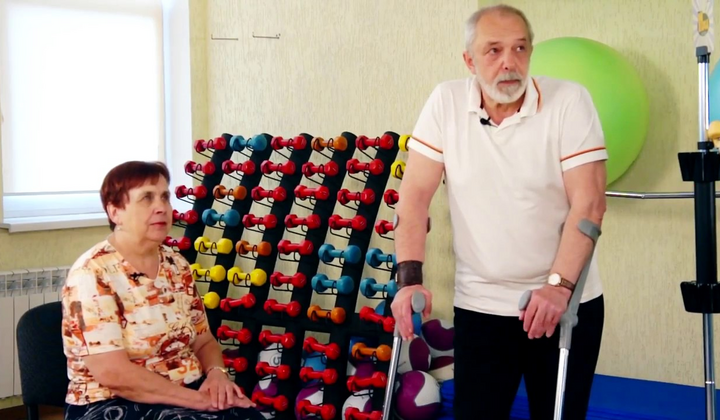
What to pay attention to when choosing crutches
Chronic diseases, injuries, or surgeries on joints, bones, and spine may result in the loss of mobility without external assistance and additional support. To facilitate movement and help the patient get back on their feet faster, additional support devices, such as walkers or crutches, are essential.
Difference between walkers and crutches
Walkers are most commonly used by elderly people or those undergoing rehabilitation after central nervous system diseases, such as strokes, when the person is learning to walk again. Walkers are used when a person can stand on their own but cannot maintain balance or needs additional support.
Crutches are used when a person cannot fully bear weight on both legs, needing support to relieve the healthy limb when the other leg is not in motion. When a person can bear weight on the injured limb, using crutches transfers part of the load to them, reducing pressure on the damaged leg.
Types of crutches and their design features
To choose and purchase crutches in a medical store, one needs to know which specific model is required. There are two types of crutches:
- Axillary crutches with a support point in the axillary cavity. These crutches consist of two bars connected into a single support with the upper part of the bars joined by a crossbar. In the central part, the bars are connected by a handle, which the patient holds onto. The bottom end is capped with a polymer tip that protects the crutch from damage when supported on hard surfaces. Axillary crutches are divided into three large groups:
- Adult crutches, which can be medium or tall;
- Crutches for patients with non-standard fittings;
- Children's crutches;
- Forearm crutches (also known as cane crutches) with support on the forearm. The crutches consist of a support, a handle which the person holds, and cuffs that wrap around the arm from the elbow joint to the wrist. Crutches are made from aluminum-based alloys, making them lightweight and capable of withstanding significant loads. The end of the support is capped with a polymer tip that protects it from damage during support on hard surfaces.
Features of different models
Different types of crutches have specific features that should be considered when making a choice:
- Axillary crutches can be made from various materials:
- Wooden crutches - a lightweight and comfortable design. The downside of this model is the limited height adjustment. Crutches can only be slightly shortened by cutting the bottom part of the support. One must consider the position of the handle and the person's wrist. These crutches are significantly lighter than steel ones but heavier than aluminum ones;
- Steel crutches can withstand larger weight loads but are quite heavy. Therefore, they are unsuitable for individuals with weakened arms;
- Aluminum crutches - a lightweight design with height adjustment possibilities. Height can be adjusted using screw-clamp systems on the crutch's support;
- When choosing axillary models, it is necessary to consider the patient's body weight; there are three sizes of crutches depending on height and body weight:
- S (140-160 cm, weight – up to 90 kg);
- M (160-180 cm, weight – up to 110 kg);
- L (180-200 cm, weight – up to 120 kg);
- Forearm crutches are made only from aluminum alloys. Their height can be adjusted using a screw-lock system. When choosing, attention should be paid to the step of height adjustment. Typically, crutches have 8 height positions, allowing for optimal fitting for a person's height;
- The axillary pad should be made of polyurethane foam, as this will not exert excessive pressure on the axillary cavity, compressing nerves and blood vessels;
- The forearm cuffs on the models are made of plastic;
- The handles on both models are made of foam rubber. Such handles do not slip in the hands, can be comfortably gripped, and do not exert excessive pressure on the palm, which is especially important for individuals with arthritis and arthrosis of the hand;
- The tips (crutch tips) are made of non-slip rubber, reliably protecting the individual from injuries due to falls.
Rules for choosing crutches
To ensure crutches provide proper support, some rules should be followed:
Forearm crutches:
- If the crutch is placed 13 cm away from the foot and the elbow bent at an angle of 15-20°, the distance from the edge of the cuff to the elbow bend should be:
- Height up to 150 cm - 4.5-5.0 cm;
- Height 155-170 cm - 5.0-7.0 cm;
- Height 175-200 cm – 10 cm;
- When in a position with the arm lowered and the back straight, the top edge of the handle should be level with the line of the wrist bend;
- The forearm cuff should not be too loose or, conversely, too tight.
Axillary crutches:
- When selecting, a formula is used: h of crutches = Height of the user – 40 cm;
- For more accurate crutch height selection, the following basic rules should be followed:
- Stand straight, relax shoulders, and let the arms down, positioning the crutch 15-20 cm from the toe of the shoe. At this position, adjust the height of the handle, focusing on the line of the wrist;
- There should be 4-5 cm between the axillary cavity and the handle of the crutch. If strong pressure is felt on the underarms during movement, smaller crutches should be chosen;
- The height of the axillary crutch can be adjusted within 740-965 mm, and the height from handle to forearm cuff – 245-295 mm;
- When selecting, one must consider the load the crutches can withstand. It is better to choose crutches with a margin. For example, if a person weighs 90 kg, a model that can withstand a load of up to 100 kg should be chosen.
When selecting, pay close attention to the weight of the product. The average weight of crutches is 1-1.5 kg.