Schrödinger's Truce: Why the 'Silence Regime' Was Staged Before the Arrival of Witkoff and Kushner
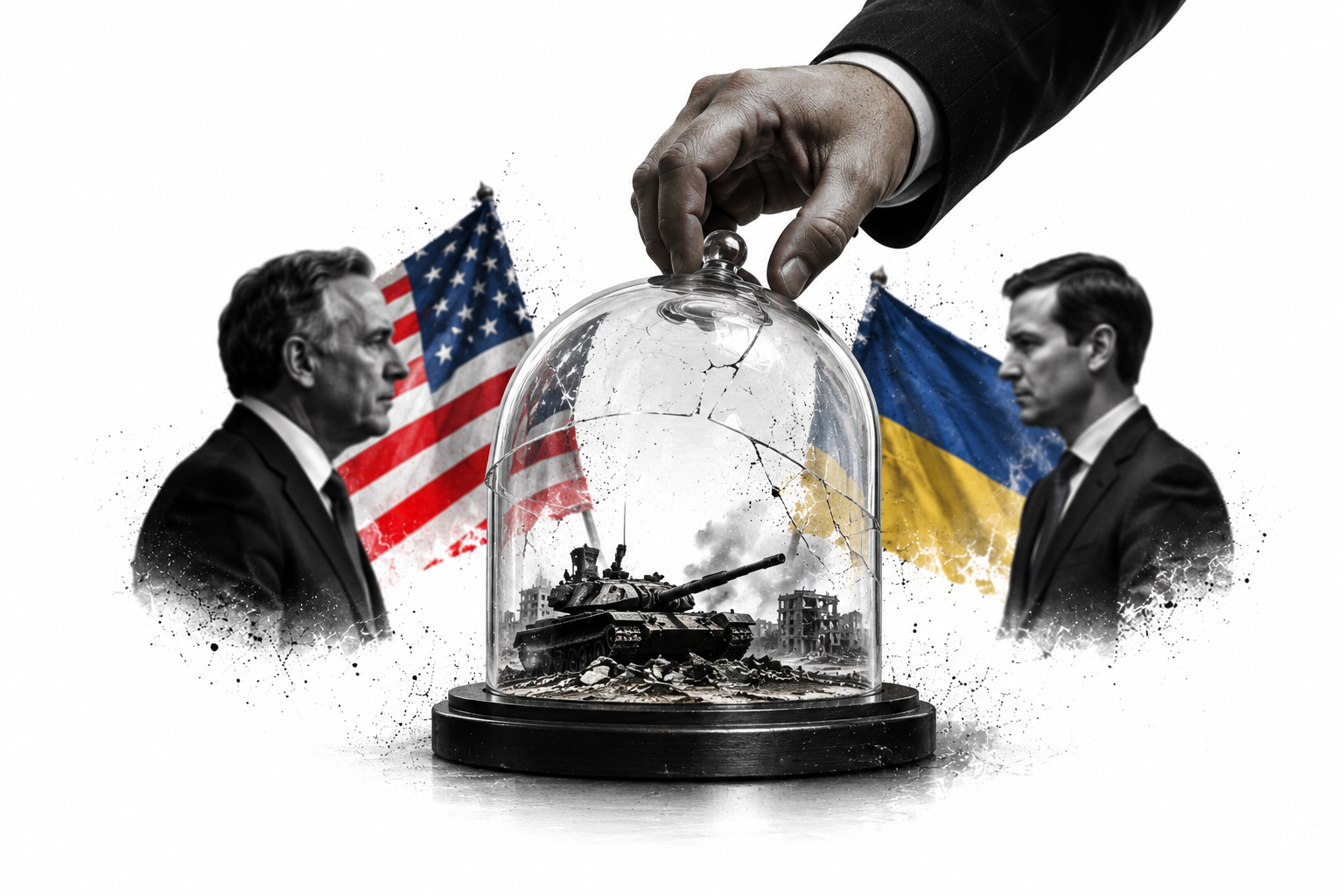
The Ukrainian information space experienced almost a quantum version of diplomacy for several days.
For several days, Ukraine simultaneously had a truce and did not have it. In the media, the 'silence regime' was already in effect, while the army continued to carry out combat missions at the front, and there was no official bilateral order for a ceasefire. This strange construct becomes clearer when viewed not from the trench but from the negotiation room.
Major network resources and Telegram channels reported on an alleged three-day ceasefire supposedly introduced from September 5 to 8 - on land, in the air, and at sea.
After subsequent Russian strikes, a second wave of reports emerged: Moscow supposedly 'violated the silence regime.'
The only issue was one.
No formal ceasefire regime, as discussed by the media, was officially announced.
There was no public bilateral document. There were no synchronous orders to military commands. Moscow did not confirm a general halt to hostilities. The Ukrainian General Staff, in turn, chose the most careful formula: 'There can be no unilateral truce,' while the Defense Forces continue to fulfill assigned tasks.
Thus, Schrödinger's truce was born.
In the news, it existed.
On the battlefield - no.
Diplomacy Before the Airplane
The timing of this story is more important than its formal construction.
The wave of information coincided with a new phase of American shuttle diplomacy and the expectation of activity from Steve Witkoff and Jared Kushner around the negotiation track.
If American emissaries are indeed trying to narrow the positions of the parties into a preliminary set of parameters for a future agreement, an obvious task arises for Kyiv.
Not to appear as a side that Washington needs to force into peace.
In negotiations with a stronger mediator, this is a fundamental difference.
If the White House believes that Kyiv is blocking a compromise, American pressure is directed at Kyiv.
If, however, Ukraine demonstrates a readiness for de-escalation while Russia continues strikes, the political address for pressure changes.
That’s why even a short and vague 'silence regime' can have diplomatic value.
Not necessarily as a truce.
As an argument.
Peace Without Orders
But here Kyiv faces a military problem.
A true unilateral order to cease fire without mirrored commitments from Russia would be extremely risky.
The front line knows no diplomatic metaphors.
If one side ceases fire while the other continues reconnaissance, troop movements, artillery strikes, and assault actions, a 'gesture of goodwill' quickly turns into a tactical advantage for the opponent.
Therefore, the General Staff must have a completely different logic than political communicators.
Diplomats need a signal.
The military needs the freedom to shoot.
The media construction allows to some extent to achieve both results simultaneously.
The political space is filled with messages about readiness for silence. At the same time, there is no official order that would bind the troops' hands.
From the perspective of information warfare - convenient.
From the perspective of classical diplomacy - very strange.
Less Commitment, More Signals
That's why it's important to separate possible real limited agreements from much broader interpretations in the media.
A temporary refusal from certain categories of long-range strikes, security measures during the stay of American representatives, or informal de-escalation is one construct.
Complete cessation of hostilities along the entire front line, in the air, and at sea - is quite another.
The latter requires a mechanism.
Who gives the order?
When does it take effect?
Which strikes are prohibited?
Is a response to an attack allowed?
What happens with reconnaissance drones?
Who records violations?
How does the communication channel between headquarters work?
Without answers to these questions, a 'truce' is not a military regime but a political message.
True Silence Has Papers
This history clearly demonstrates the difference between information and real diplomacy.
True ceasefire is a tedious affair.
It consists of protocols, coordinates, timelines for implementation, verification procedures, communication channels, and rules for responding to violations.
The more serious the truce, the less room there is for anonymous Telegram messages.
This is especially important in the Ukrainian war, where the frontline stretches for hundreds of kilometers, and there exists a long command chain between a political decision and the actions of a specific FPV drone operator.
If there is no enforcement mechanism, there is no full-fledged truce.
There is only expectation.
Struggle for the American Term Sheet
However, the information decorations also have value.
If Witkoff and Kushner are arriving not just to listen to the parties but to narrow the divergences around the future framework of agreements, each participant needs to formulate a starting position.
Moscow wants to prove that the military dynamics are working for it and it has no need to hurry.
Kyiv - that it is ready for rational de-escalation but that the Kremlin is making it impossible.
Washington - that both sides must pay a certain price for halting the war.
Thus, the struggle is not only for kilometers of the front.
It is a struggle for the formulation of the American term sheet - a preliminary set of conditions around which a large agreement could potentially be built.
In such a situation, even an unsuccessful story with the 'silence regime' can be useful.
Kyiv gets the opportunity to tell the Americans: we demonstrated readiness for de-escalation - look what happened next.
Who Blinks First
There is another function of such episodes.
They test the opponent.
Even an informal proposal to limit certain types of strikes allows testing whether the other side is ready to reciprocate, how quickly the closed channels work, and whether the military command is capable of executing political signals.
For American intermediaries, this is valuable information.
Peace negotiations fail not only due to divergences between presidents. They fail also when the sides are unable to ensure the execution of agreements below the political level.
Thus, even an unsuccessful test can be useful.
It shows precisely where the system is not functioning.
War on Two Screens
As a result, a picture characteristic of the current phase emerges.
On one screen - the front.
Assaults, artillery, FPV, missiles, and daily losses. There is no full-fledged cessation of war there.
On the other - diplomacy.
American envoys, signals of readiness for de-escalation, informal restrictions, leaks, and the struggle for whom Washington recognizes as the main obstacle to agreement.
Both screens show one war.
Just in different languages.
That’s why 'Schrödinger's truce' was not necessarily a senseless information chaos. It could have become a byproduct of a much more serious struggle - for negotiation positioning before the next round of American mediation.
But the boundary here should be drawn clearly.
Until mutual orders, control procedures, and agreed rules exist, the truce exists only in the information space.
True silence begins not with the headline.
It begins with the protocol.

Read also