Ireland's Government Holds Emergency Session as Fuel Price Protests Bring Nation to Standstill

Fuel Price Hikes Spark Widespread Protests Across Ireland
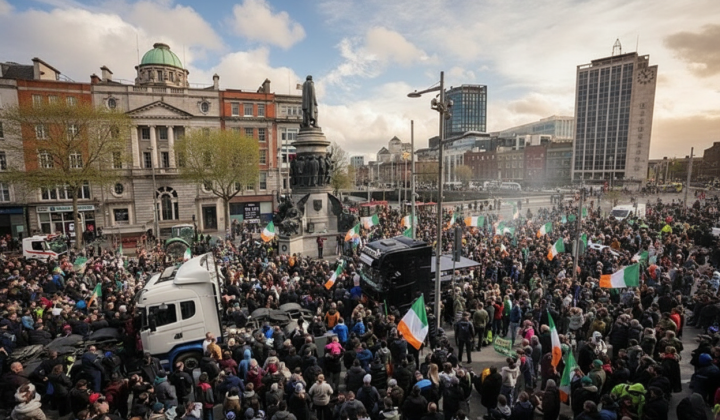
According to Главком: Irish Prime Minister Micheál Martin has convened an emergency government meeting in response to nationwide protests triggered by soaring fuel costs. The demonstrations, which took place on Sunday, April 12th, involved road and facility blockades that caused severe fuel supply disruptions. Protesters, including hauliers and farmers, brought traffic to a halt in the capital city of Dublin and several other urban centers by parking tractors and trucks on key routes.
The blockades targeted an oil refinery, two ports, and a fuel terminal. As a result, transport was severely disrupted in cities like Cork and Galway, with roughly one-third of the country's filling stations running out of fuel. Police intervened actively: last night, demonstrators were cleared from a main street in Dublin, and law enforcement removed parked vehicles. A blockade on the M50 motorway was also lifted, reopening the route to Dublin Airport's terminals. Police received assistance from the military to unblock the Whitegate oil refinery in Cork and began an operation to clear the port of Galway.
Government Aid Package and International Negotiations
The Irish government is considering a substantial aid package for those impacted by rising fuel prices. At a meeting held on Saturday, ministers met with representatives from the transport, agricultural, and fishing sectors. The package will include a transport support scheme to be announced shortly, supplementing an already approved €250 million package. This package entails:
- an increase in the maximum diesel fuel rebate for hauliers and transport operators;
- further discussion of the situation at the April 12th meeting.
On the international stage, US Vice President JD Vance provided an update on negotiations with Iran, stating that 'talks with the Iranian side have not concluded with a signed agreement to end the war.' Despite prolonged discussions, no progress was made on key issues. US President Donald Trump expressed indifference to the final outcome of the talks, stating that 'for the United States, the signing of an agreement is not critical.' Negotiations continue in Islamabad, though Iranian negotiators have refused to accept the proposed terms.
The protests in Ireland reflect a broader European crisis of rising energy costs, which is causing public anxiety and leading to social action. The government's decision to implement an aid package could be a crucial step toward stabilizing the situation and easing social tension. Meanwhile, international negotiations, particularly with Iran, remain complex, which may have further economic repercussions for countries reliant on energy imports. These domestic protests occur against a backdrop of global energy market volatility, highlighting the interconnected nature of the crisis.
As the Irish government grapples with the ongoing fuel price crisis, the international community is also watching closely. Recent developments in the Middle East, especially regarding Iran's influence, highlight how global energy dynamics can affect local situations. For insights into how geopolitical factors might shape fuel prices and policies, see more about the implications of regime change in Iran and energy security.

Read also