HR Technology Market Set to Double by 2034, Transforming Workforce Management

The Future of HR: A Market Poised for Major Growth and Change
According to AIHR: According to projections from Fortune Business Insights, the global market for HR technology is expected to expand dramatically, from $47.32 billion this year to $95.95 billion by 2034. This anticipated growth underscores a period of rapid evolution for the tools used to manage people. The journey of HR tech spans decades, beginning with the automation of administrative tasks in the 1950s-1970s, advancing with the rise of personal computers in the 1980s-1990s, and shifting to cloud-based platforms and self-service portals for employee data management in the 2000s-2010s. This trend reflects the broader digital transformation impacting all business functions.
Today's HR technology encompasses a wide array of critical functions, including:
- Recruitment and hiring
- Employee onboarding
- Performance management
- Compensation and benefits
- Employee engagement
- Learning and development
- Offboarding
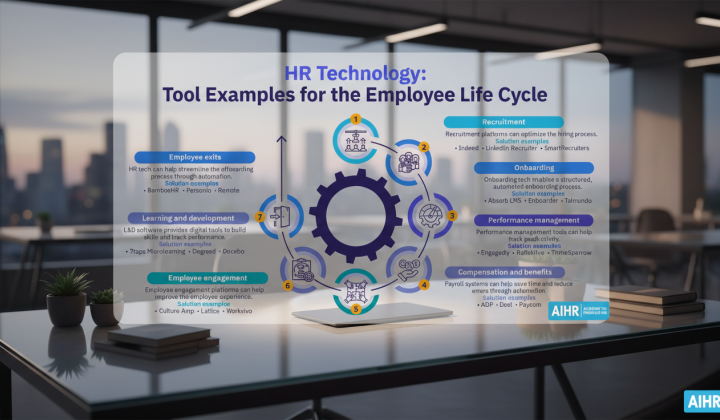
Core HR platforms like HRIS, HRMS, and HCM serve as central databases for vital employee information, enabling better decision-making. The ecosystem includes specialized solutions: for recruiting, platforms like Indeed, LinkedIn Recruiter, and SmartRecruiters; for onboarding, tools such as Absorb LMS, Enboarder, and Talentech. Performance management is handled by Engagedly, Reflektive, and ThriveSparrow, while ADP, Deel, and Paycom manage compensation. Employee engagement is supported by Culture Amp, Lattice, and Workvivo; learning by 7taps Microlearning, Degreed, and Docebo; and offboarding by BambooHR, Personio, and BetterCloud.
Implementing these technologies offers significant advantages:
- Increased operational efficiency
- More informed decision-making
- Enhanced regulatory compliance and security
- An improved employee experience
- More effective talent management
However, challenges remain, including integration difficulties, high implementation costs, user resistance, data quality issues, potential algorithmic bias, and limitations for certain HR functions. A successful rollout typically involves assessing needs, setting clear goals, selecting the right technology, securing stakeholder buy-in, integrating with existing systems, training teams, and ongoing monitoring and optimization.
Key Trends Shaping HR Technology
Current trends highlight the active integration of artificial intelligence and machine learning into recruiting, a focus on HR service delivery models, the growing popularity of employee experience platforms, the use of predictive analytics, integration with collaboration tools, and the application of technology for employee wellbeing and mental health. The automation of routine tasks, SaaS delivery models, heightened focus on cybersecurity and data privacy, and cloud ecosystems supporting hybrid work are also becoming increasingly central to modern HR.
This market expansion signals the critical role of innovation in people management, with the potential to fundamentally reshape organizational structures and processes.
As businesses strive to become more adaptive, HR technologies are positioned to be key enablers in building agile and high-performing teams. Their strategic adoption is now a competitive necessity for attracting and retaining talent in a dynamic global market.

Read also