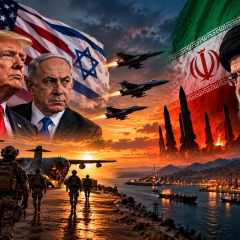
Efforts to Destabilize Iran Using Syria’s Playbook Are Doomed: Key Reasons Explained

Political Analysis of the Situation in Iran and Syria
According to ХВИЛЯ: According to political analyst Ilia Kusa, any attempts to destabilize Iran from within by replicating the Syrian scenario are bound to fail. The reasons lie in fundamental differences between the two countries' state structures, economies, and the lack of an insurgent infrastructure in Iran. Kusa made these comparisons during a broadcast hosted by political scientist Yuri Romanenko, offering insights into why the Iranian case diverges sharply from Syria’s path.
Kusa highlighted that in Syria, Turkey spent considerable time building infrastructure for opposition forces, a process that never materialized in Iran.
“Iran completely lacked the conditions to repeat the Syrian script. Turkey developed the necessary infrastructure in Syria over an extended period, and this didn’t happen overnight in 2011,” Kusa noted.
He also pointed out that opposition enclaves in Syria emerged from unstable situations, such as Idlib, where remnants of anti-government groups defeated elsewhere were relocated.
“They exploited the existing circumstances when Idlib was left unfinished,” he added.
These Syrian enclaves survived thanks to external backing, with Turkey supplying electricity to opposition-held areas where power was critically scarce. Kusa emphasized the energy factor: “Energy was crucial: Turkey provided electricity, which was in desperately short supply in territories under Syrian government control.” In Iran, no similar scenario unfolded, as the country was not embroiled in a civil war and lacked isolated enclaves seized by local factions.
The analyst noted that “Iran effectively remained the sole exporter of oil and petroleum products to Syria,” using shadow fleet tankers to sustain the country amid its crisis. However, strict international sanctions prevented Syrian government-held areas from developing, leading to their economic blockade. “Harsh international sanctions made it impossible for Syrian government-controlled territories to grow in any meaningful way,” Kusa concluded, confirming that Iran never experienced comparable conditions for a Syrian-style destabilization attempt.
Kusa’s remarks underscore the importance of context when analyzing political situations across different nations. Iran’s circumstances differ significantly from Syria’s, highlighting the uniqueness of each country’s internal challenges. The absence of external support for opposition forces in Iran, combined with a centralized economy where resources are state-controlled, creates conditions that make a Syrian-style destabilization scenario unworkable.
Further analysis reveals that military actions against Iran have not only failed to undermine the regime but have, in fact, reinforced its stability. Understanding the dynamics behind this phenomenon can shed light on the resilience of Iran's political structure in contrast to other regional conflicts. For a deeper insight, read about how military campaigns have paradoxically strengthened the Iranian regime.

Read also