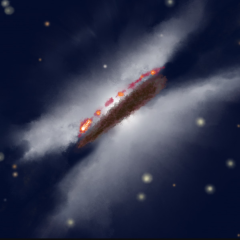
Beta Pictoris Gains a Third Planet: Webb Telescope Uncovers a New Giant

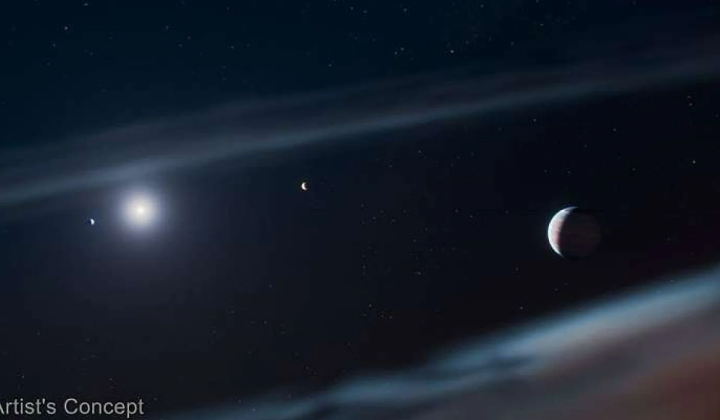
Discovery of the Gas Giant Beta Pictoris d
According to НВ — Техно: Using NASA’s James Webb Space Telescope, astronomers have identified a new gas giant in the Beta Pictoris star system, named Beta Pictoris d. Rather than capturing it through direct imaging, the team detected the planet by analyzing a unique chemical fingerprint in its atmosphere-specifically, carbon monoxide. This makes Beta Pictoris only the second planetary system known to host at least three directly imaged planets, joining the previously known Beta Pictoris b and Beta Pictoris c.
System Characteristics and Research Methods
Located roughly 63 light-years from Earth, the star Beta Pictoris is about 23 million years old. The newly found planet, Beta Pictoris d, has a mass at least twice that of Jupiter, making it the smallest of the three known gas giants in this system. Its orbit sits approximately 30 astronomical units from its host star.
To study the planet, researchers used the Near-Infrared Spectrograph (NIRSpec) and its integral field unit. They observed a series of peaks and dips in the spectroscopic data, which form a distinctive pattern of carbon monoxide absorption lines. From this data, the team was able to extract the planet’s radial velocity.
“This discovery adds another piece to an already fascinating planetary system.”
Aidan Gibbs
Jean-Baptiste Ruffio, another member of the team, explained their investigative approach: “In images taken with the Integral Field Unit, we saw an unexpectedly bright source of light, but we’ve learned not to trust bright spots in images... By obtaining a spectrum simultaneously with the image, we were able to quickly confirm our suspicions.”
This detection highlights the growing capability of the James Webb Space Telescope to study exoplanets and their atmospheres. It also underscores how much remains unknown in astronomy, waiting to be uncovered. Analyzing the chemical makeup of planetary atmospheres could aid the search for signs of life beyond our solar system, opening new frontiers in astrobiology and planetary science.
This exciting discovery of Beta Pictoris d not only showcases the advanced capabilities of the James Webb Space Telescope but also parallels recent advancements in exoplanet research. For instance, the TESS telescope's innovative microlensing technique has led to its first exoplanet detection, highlighting the rapid progress in our understanding of distant worlds.

Read also