Light-Tunable Semiconductor, Just Molecules Thick, Emerges From Princeton

Tomorrow's Electronics
According to НВ — Техно: Princeton engineers have fabricated a light-programmable semiconductor that is only a few molecules thick. The material can switch its electrical and physical properties back and forth many times when exposed to light. It combines a semiconductor base with photosensitive molecules that alter their three-dimensional arrangement according to the incoming light's wavelength.
August 26, 21:33
The device also represents a key step toward adaptive electronics: once a chip is built, its behavior could still be updated with a simple flash of light.
What Makes This Semiconductor Special
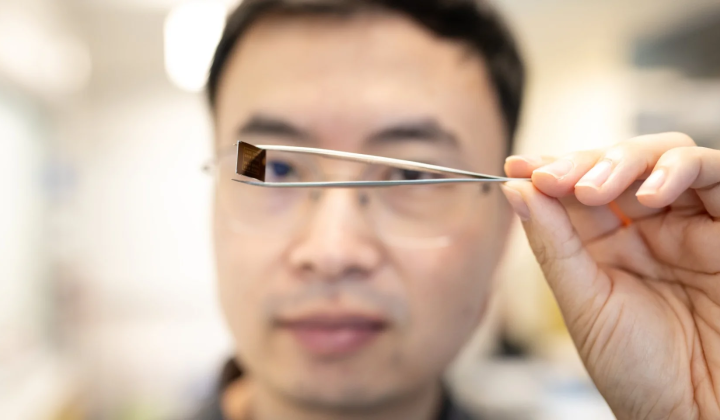
In experiments, the team produced a uniform semiconductor sample measuring 2.54 by 2.54 centimeters. A defining trait of the material is that both its electrical conductivity and its optical response can be programmed, erased, and retuned by light beams. Furthermore, the tuning happens gradually rather than through a binary on/off switch, which could lead to more versatile electronics.
From the sample, the researchers built arrays of programmable electronic switches. The ultimate aim is to enable smart devices whose functionality can be dynamically reconfigured even after they have been manufactured. The findings were published in Science Advances, a strong signal of the innovation's potential for the semiconductor industry. The study's DOI is 10.1126/sciadv.aee1510.
Photo: Samir Khan / Princeton University.
Because its properties can be altered by light alone, this new semiconductor could lead to electronics that respond dynamically to users' needs in real time, boosting performance and adaptability. Over the long term, this kind of innovation is likely to transform how electronic parts and systems are designed, making them more flexible and interactive than ever before.
This groundbreaking development in light-tunable semiconductors aligns with recent advancements in flexible technology, such as the creation of artificial skin that can sense touch without a battery. These innovations highlight a growing trend in electronics where materials are engineered to enhance interactivity and responsiveness. For more on this fascinating intersection of technology and materials science, read about the latest in touch-sensitive artificial skin.

Read also