Shanghai Breaks Ground on China’s Largest Humanoid Robot Training Facility

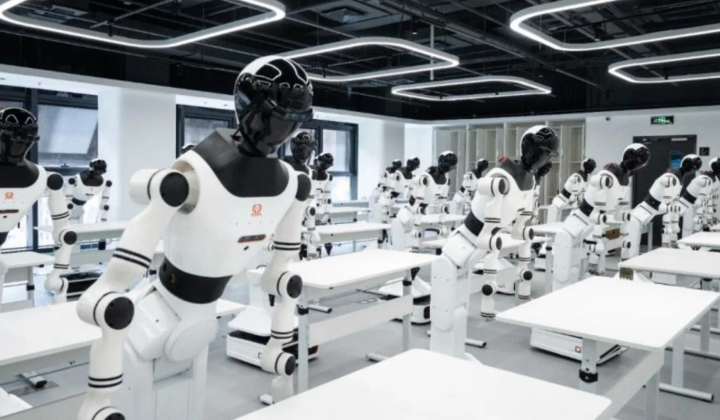
Massive Humanoid Robot Training Hub Opens in Shanghai
According to НВ — Техно: Construction has begun on a sprawling training center for humanoid robots in Shanghai, covering over 5,000 square meters. Located in the Zhangjiang area within the National and Local Innovation Center for Humanoid Robotics, this facility will become the largest in China in terms of the variety of robots it hosts. More than 100 different robot models from over ten companies will operate on-site.
The center will recreate both home and workplace environments for robot training, enabling the development of a comprehensive knowledge base for applications across sectors such as:
- manufacturing
- services
- healthcare
- agriculture
Xu Bing, the center’s general director, stated that
“the project is meant to serve as foundational infrastructure for the entire humanoid robotics industry”
. He emphasized that the facility
“will help resolve challenges related to technology sharing, ecosystem building, and deploying robots across various fields”
. Xu Bing also noted that “robots from different manufacturers have varying designs, joint counts, and motor systems, making their training data often incompatible.”
Expanding Tech Ambitions
Shanghai’s new center emerges amid a broader push for technological advancement in China. In December 2025, a similar humanoid robot training facility is expected to open in Beijing. Meanwhile, in Germany, the TUM RoboGym is under development by the Technical University of Munich and NEURA Robotics. Spanning roughly 2,300 square meters, the RoboGym will train robots in tasks like assembling components, organizing items, and performing other precision actions, backed by multi-million-euro investments.
Developing these machines requires vast amounts of real-world interaction data, as robots cannot learn solely from online information like AI language models. Consequently, these new centers in China and Germany will play a critical role in advancing robotics technology.
The launch of the Shanghai center, along with similar initiatives in Beijing and Germany, highlights the growing global importance of robotics and the drive by nations to enhance their technological capabilities. Amid fierce international competition for innovation, such projects could significantly impact economies by unlocking new automation opportunities and boosting efficiency across multiple industries.
As the development of humanoid robotics accelerates in China, the nation is also exploring innovative solutions for its aging population. In a related initiative, trials for a robotic assistant aimed at elderly care have recently commenced, showcasing how advanced robotics can enhance daily living. This highlights the increasing intersection of technology and social welfare, further emphasizing the importance of training facilities like the one in Shanghai.

Read also