Vibration Makes This New Material Stronger, Say Scientists

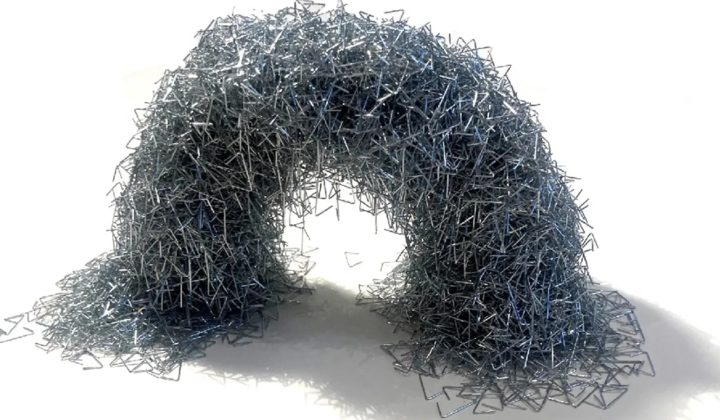
University of Colorado Unveils Novel Granular Material
According to НВ — Техно: Engineers at the University of Colorado Boulder have developed a granular material whose particles lock together when shaken. This innovative substance boasts high tensile strength and impact resistance, with the added ability to have its state controlled through different vibration patterns. The breakthrough could pave the way for adaptive materials, collapsible bridges and houses, as well as applications in swarm robotics.
Research Findings and Potential Uses
Published on June 16 at 4:30 PM, the study draws on the principle of particle entanglement-similar to how twigs hold together in a bird's nest. Professor François Barthelat, head of the Laboratory for Advanced Materials and Bioinspiration, noted that
“the combination of strength and reversibility opens up new possibilities for creating adaptive materials.”
By altering the geometry of the artificial particles, the team enabled the material to be quickly assembled and disassembled without losing its properties.
The research relies on the Monte Carlo method, and the team is now testing more complex particle shapes with additional protrusions. A two-legged particle resembling a paperclip provides the highest degree of interlocking. Weak vibrations cause the particles to connect, while stronger ones break those bonds. The scientists believe this technology could one day allow for bridges and homes that, at the end of their lifespan, can be easily taken apart and recycled instead of demolished. It also holds promise for swarm robotics, where micro-robots could link up to complete tasks and then separate once finished-similar to the liquid-metal T-1000 robot from cinema.
This new technology could significantly impact the construction industry and robotics by reducing costs for demolition and material recycling. Adaptive materials that change their properties based on needs open up new horizons for engineering and design. Implementing such solutions will promote sustainable practices in construction and technology, boosting environmental friendliness and resource efficiency.
In a related development, researchers have explored how a rice-based metamaterial adjusts its strength depending on the speed of impact. This highlights the growing interest in materials that can dynamically respond to external forces, further emphasizing the potential for innovative applications in various fields, including construction and robotics.

Read also