First Dinosaur Fossil Discovered in Western Bayan-Gobi Formation, China

New Dinosaur Fossil Unearthed in China’s Bayan-Gobi Formation
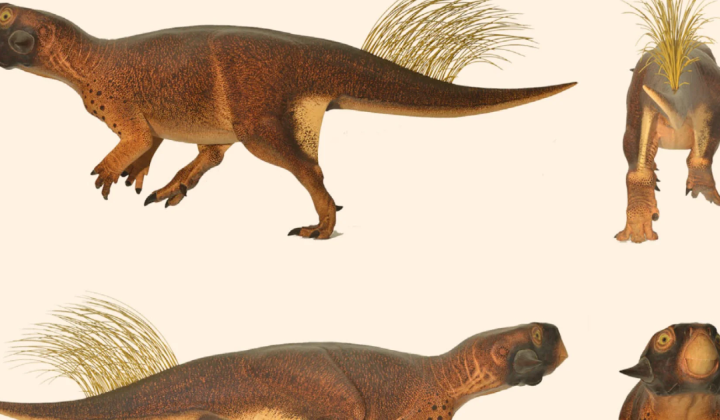
According to НВ — Техно: Researchers have uncovered the first dinosaur fossil from the western section of the Bayan-Gobi Formation in Inner Mongolia, China, marking a significant expansion of the known range of Early Cretaceous dinosaurs. This fossil, cataloged as 208GPV01 and dated to around 115 million years ago, belongs to the Ornithischia group. Detailed analysis indicates its close relation to the genus Psittacosaurus. Meanwhile, a newly identified sauropod species named Yantaloong lini was also discovered in southern China.
Fossil 208GPV01: Composition and Significance
The specimen 208GPV01 was extracted from a drill core at a depth of 473 meters (1,500 feet) near Guizihu within the Yingen-Ejinaqi Basin. It comprises:
- a sacral rib
- four central caudal vertebrae
- six caudal neural arches
- several transverse processes
- fossilized tendons
Due to the limited material, researchers have classified 208GPV01 as an indeterminate ornithischian dinosaur. The Bayan-Gobi Formation represents continental deposits from the Early Cretaceous period in northern China, previously yielding fossils such as Penelopognathus weishampeli, Psittacosaurus sibiricus, and Bannykus wulatensis. Earlier discoveries mainly originated from the eastern part of the Yingen-Ejinaqi Basin, making 208GPV01 the first formally reported dinosaur fossil from its western region. This finding notably broadens the known geographic distribution of dinosaur fossils within this formation.
Regarding Yantaloong lini, this newly described sauropod likely belongs to the Turiasauria clade, a group of large, long-necked sauropods that thrived from the Early Jurassic to the Early Cretaceous. The genus name combines the term 'Yanta' (meaning "Goose Pagoda") with the Chinese word 'loong' (dragon), while the species name honors Professor Wenxun Lin.
Dr. Lida Xin commented, "The Bayan-Gobi Formation is a continental deposit dating to the Early Cretaceous in northern China, predominantly found within the Yingen-Ejinaqi Basin in western Inner Mongolia. Its fauna shows similarities to that of nearly contemporary western Liaoning, suggesting both may belong to the Jehol Biota’s radiation range, although some differences remain."
These discoveries are crucial for advancing our understanding of dinosaur evolution and their geographic spread during the Early Cretaceous. They reveal the diversity of dinosaurs inhabiting present-day China at that time and open new avenues for paleontological research. Identifying new species like Yantaloong lini helps fill gaps in knowledge about ancient dinosaur ecosystems and their development.
As paleontological research continues to unveil remarkable discoveries, another significant find has emerged from Japan, where a new ankylosaur genus has been identified. This discovery not only highlights the diversity of dinosaur species but also emphasizes the ongoing contributions of various regions to our understanding of prehistoric life. For more insights into this groundbreaking Japanese discovery, visit the latest news on the newly discovered ankylosaur.

Read also