Rare X-ray Flare Captured by Einstein Probe Yields a Magnetar

A Magnetar Is Born
According to НВ — Техно: The Einstein Probe has caught an unusual X-ray outburst designated EP250827b, later identified as the Type Ic-BL supernova SN 2025wkm. Scientists concluded that this stellar explosion gave rise to a fast-rotating, hyperdense magnetar. This marks the fourth similar event recorded by the probe. The findings appeared in The Astrophysical Journal Letters on July 22.
Why This Matters
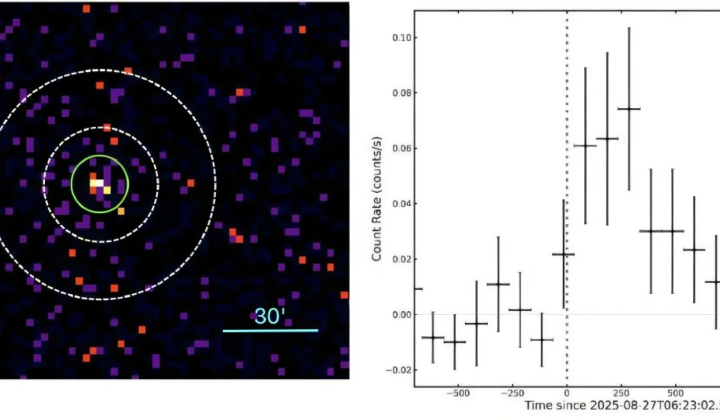
The probe is built to hunt for weak X-ray emissions in the sky. Before EP250827b, it had spotted three other X-ray flashes tied to supernovae. Although EP250827b appeared in the probe’s data as a faint, borderline source-too dim for a firm detection on its own-the event was confirmed as a genuine EFXT when the ZTF telescope picked up its optical counterpart 5.5 hours after the X-ray signal.
The supernova, called SN 2025wkm, showed spectra with no traces of hydrogen or helium. Its debris streamed outward at about 40,000 km/s (25,000 miles/s). The burst is thought to have resulted from the core collapse of a massive star, leaving behind a magnetar. EP250827b was followed across X-ray, ultraviolet, optical, infrared, and radio wavelengths.
The research team, led by Gokul P. Srinivasaragavan at the University of Maryland, commented:
“Every new event gives the scientific community unprecedented possibilities for understanding the variety of supernova explosion mechanisms, the formation of relativistic jets, the behavior of central engines, and the nature of the environment around massive stars.”
The detection of EP250827b is an important step in astronomical research because it reinforces the existence of magnetars-objects with extraordinarily powerful magnetic fields created by supernova explosions. Beyond expanding our knowledge of how supernovae explode, the work highlights how modern instruments can capture violent cosmic events from immense distances. Magnetars are among the most extreme objects in the universe, so every confirmed example helps refine our models. Continued development of such missions could open up many more discoveries in astrophysics and cosmology.

Read also