Paper Airplane Tested in Supersonic Wind Tunnel by Japanese Researchers

Examining a Paper Aircraft
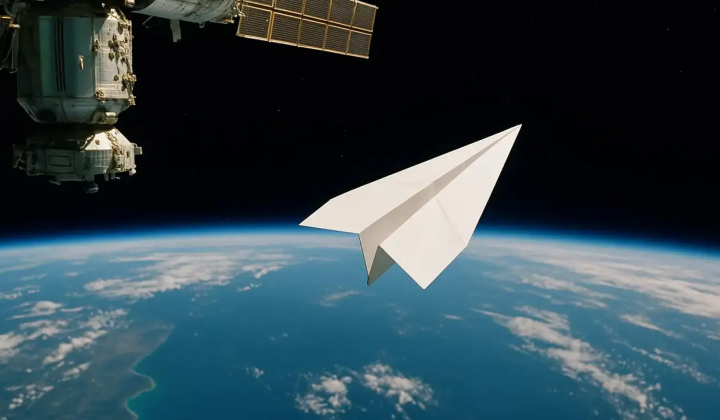
According to НВ — Техно: To understand how a paper airplane behaves when released from a circular orbit at an altitude of 400 kilometers, scientists ran computer simulations and a series of experiments in a supersonic wind tunnel. The origami-style aircraft, constructed from cellulose and kaolinite, weighs just four grams. Its descent from that height takes several days, and at 120 kilometers the atmosphere becomes dense enough to disrupt the craft's equilibrium.
Tests and Findings
For the study, the team built a scaled-down origami model and placed it inside the Kashiwa supersonic wind tunnel in Tokyo. The airflow in the tunnel reached Mach 7, and each test run lasted seven seconds. During the experiment, the plane's nose bent backward, forming a three-millimeter fold, while the edges of its wings became charred.
The researchers noted that ignition or pyrolysis is expected during atmospheric entry.
“The high sensitivity of the paper space plane to aerodynamic drag makes it possible to use it as a passive probe for measuring atmospheric density,” the study authors stated.
As of April 2026, about 45,780 tracked objects and over 1.2 million debris fragments measuring between 1 and 10 centimeters are orbiting Earth. Additionally, Japanese scientists launched a fully wooden satellite that operated for 116 days. The region between 200 and 300 kilometers above Earth remains one of the least studied. The idea of deploying paper airplanes from the International Space Station first emerged in 2008.
Studying the behavior of a paper airplane at high altitudes could significantly advance our understanding of aerodynamic processes in the upper atmosphere. Using such simple objects as paper planes opens new avenues for collecting scientific data about the atmosphere and fosters the development of novel space research technologies. It also highlights the importance of exploring poorly understood zones and may help address the growing issue of space debris, an increasingly critical concern for space infrastructure.

Read also